

QUALITY OCCULT BOOKS
& CONTEMPORARY ESOTERICA

(h)Auroræ: The recalling or retelling of the many Pasts made Present & Whole again
by G. McCaughry
Illustrations by José Gabriel Alegría Sabogal
Typeset, Layout, & Design by G. McCaughry
(h)Auroræ is, and functions as, an occult text; it is technically not a book ‘about’ the occult. The distinction is important here: the whole concept, presentation, and perennial philosophy underlying the book aim at provoking a mystical experience and stimulating the Divine Inspiration of the reader, so that they, in turn, become Inspiration.
This manuscript is a mystifying, albeit utterly profound journey. Part ontological synthesis, philosophical rambling, magickal diary, visual grimoire, mystical poetry, revelatory/individuation process, and alchemical vessel of expression, the book exists under the umbrella of what the author refers to as Neoteric Heterodoxy. First and foremost, however, (h)Auroræ exists as an act of eternal remembrance.
[read more below]
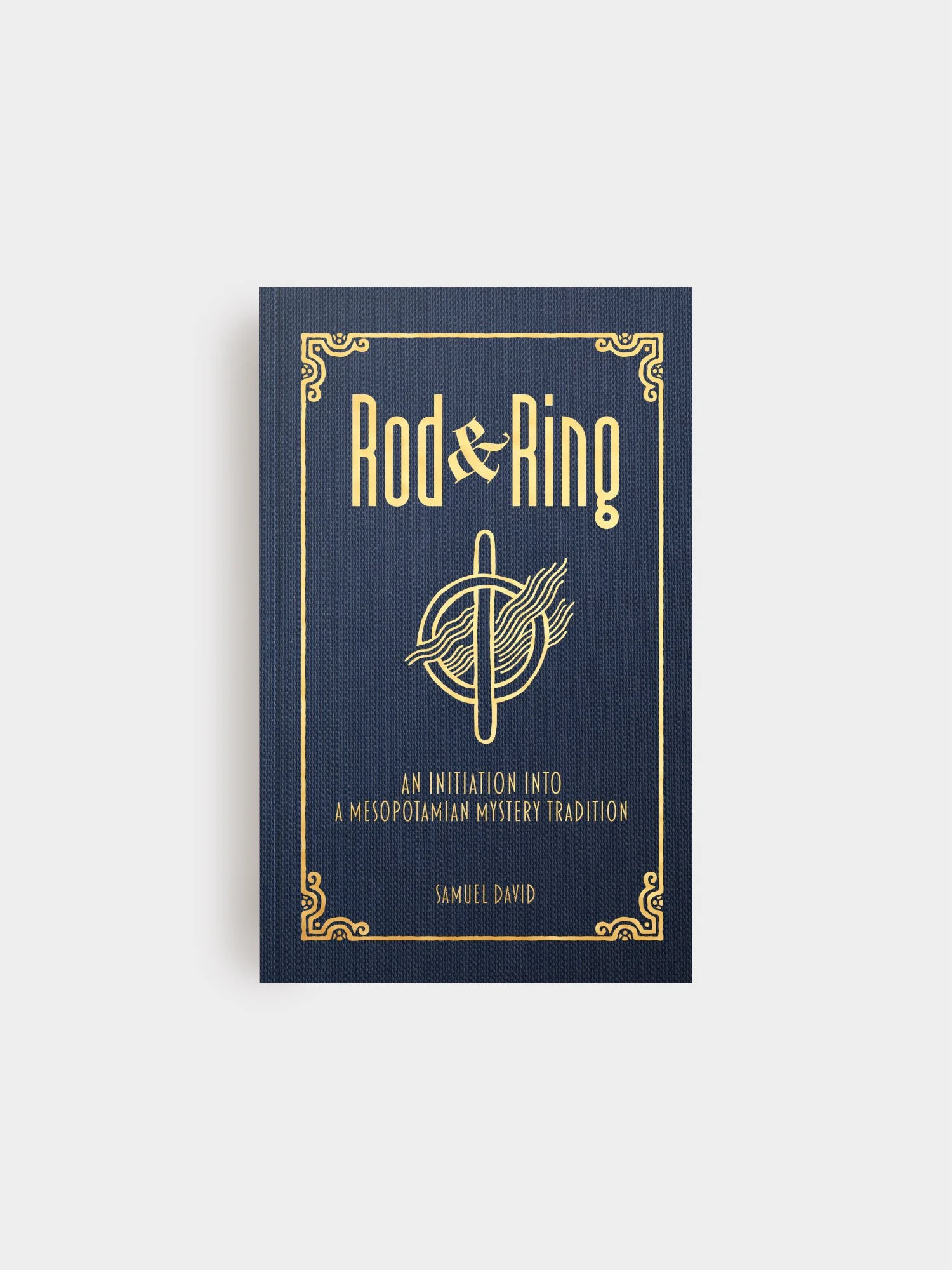
Rod & Ring: An Initiation Into A Mesopotamian Mystery Tradition
by Samuel David
Foreword to the 2025 Paperback Edition: Shea Bilé
Illustrations by Johnny Decker Miller
Typeset, Layout, & Design by G. McCaughry
History tells us of the mystery traditions of Isis, Dionysius, and Mithras – but what of the mysteries of Inanna, Enki, and Dumuzid? Author Samuel David’s Rod & Ring seeks to fill those lacunae with a spiritual journey that combines traditional Mesopotamian praxis with a contemporary paradigm.
Immerse yourself in this mystery tradition as you undertake a mythopoetic journey informed by historical, religious, and cultic practices, as well as mythology, and research from experts in the field of Assyriology.
Prepare yourself to approach the shrine of the gods as their supplicant; take up the Divine Measures bestowed upon humanity as their servant, and brave the dark as you descend into the depths of the Underworld; be reborn as the temple steward and pass through the Heavenly gates to present yourself as one worthy to be entrusted with their holy regalia: the Rod and the Ring.
[read more below]
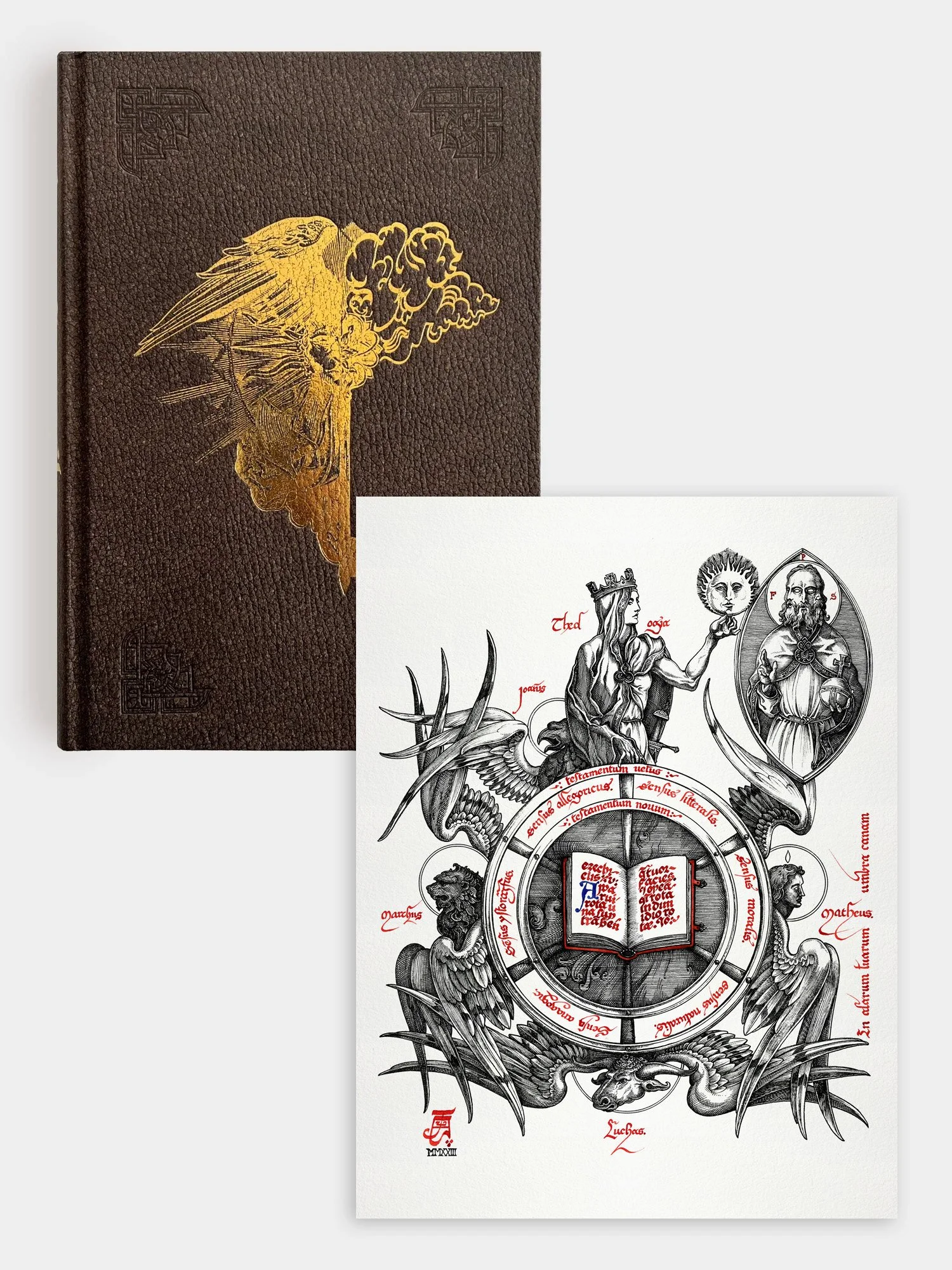
Semesilam: The Eternal Sun
+ La Teología Escolastica aka. Scholastic Theology [Art Print] - BUNDLE
by José Gabriel Alegría Sabogal
Typeset, Layout, & Design by Joseph Uccello
Semesilam: The Eternal Sun is a compilatory volume, gathering the artwork that José Gabriel Alegría Sabogal produced between 2012-2017. This ‘definitive anthology' includes the long out-of-print Handbook of Sacred Anatomy (Aeon Sophia Press, 2014) and A Second Nature (ASP, 2017), along with further, unpublished works from the same period and an extended photographic record of Sabogal’s work focusing on human skulls and bones…
[read more below…]
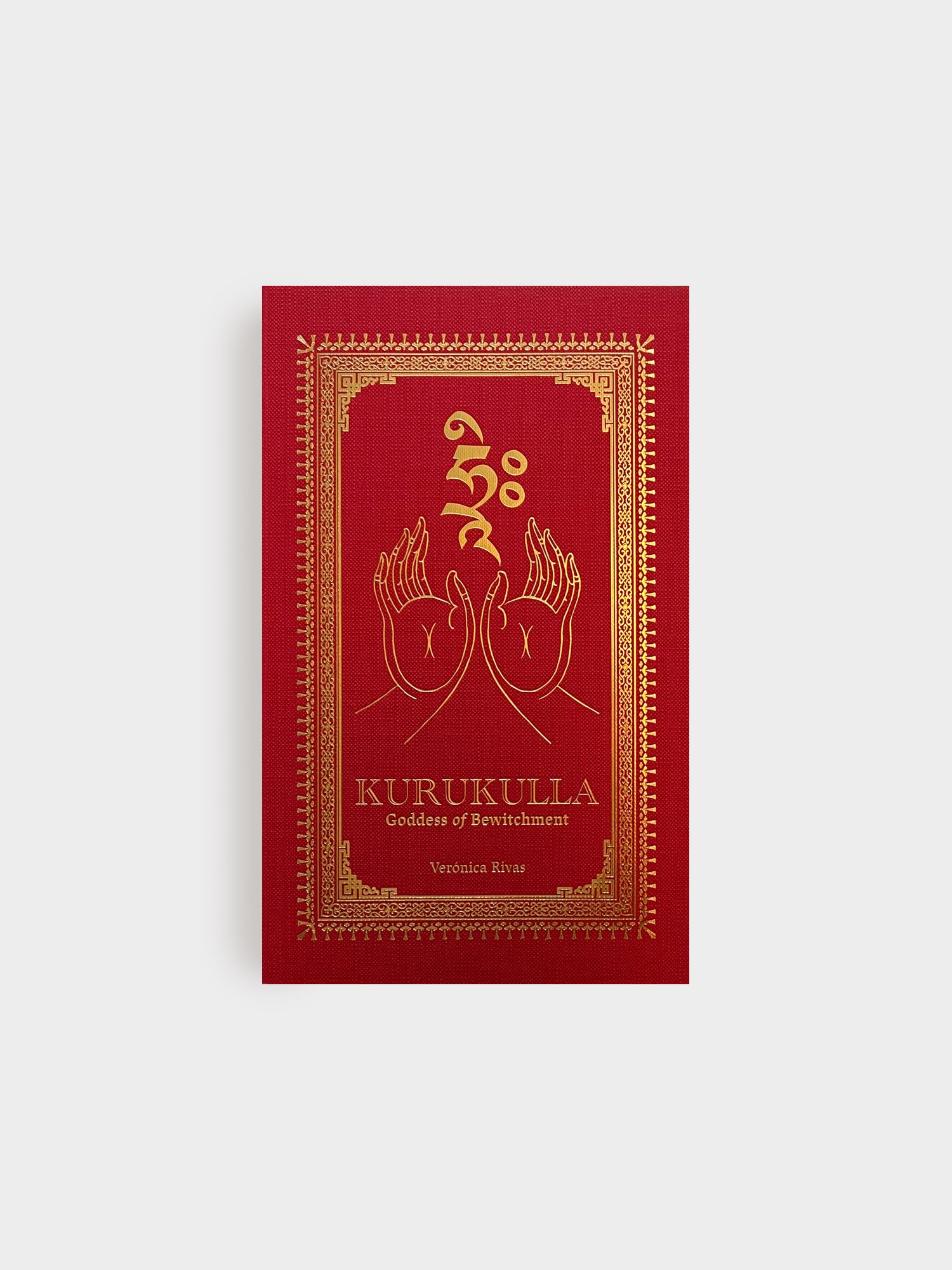
Kurukulla: Goddess of Bewitchment — A Devotional Path to the Red Enchantress of Uddiyana
by Verónica Rivas
Illustrations by An Sav
Typeset, Layout, & Design by G. McCaughry
In Kurukulla: Goddess of Bewitchment, author Verónica Rivas combines academic research with personal experience to offer a theoretical-practical study of Kurukulla, the goddess in Hinduism related to desire, lust, magic, and witchcraft.
[read more below]
NOW SHIPPING!
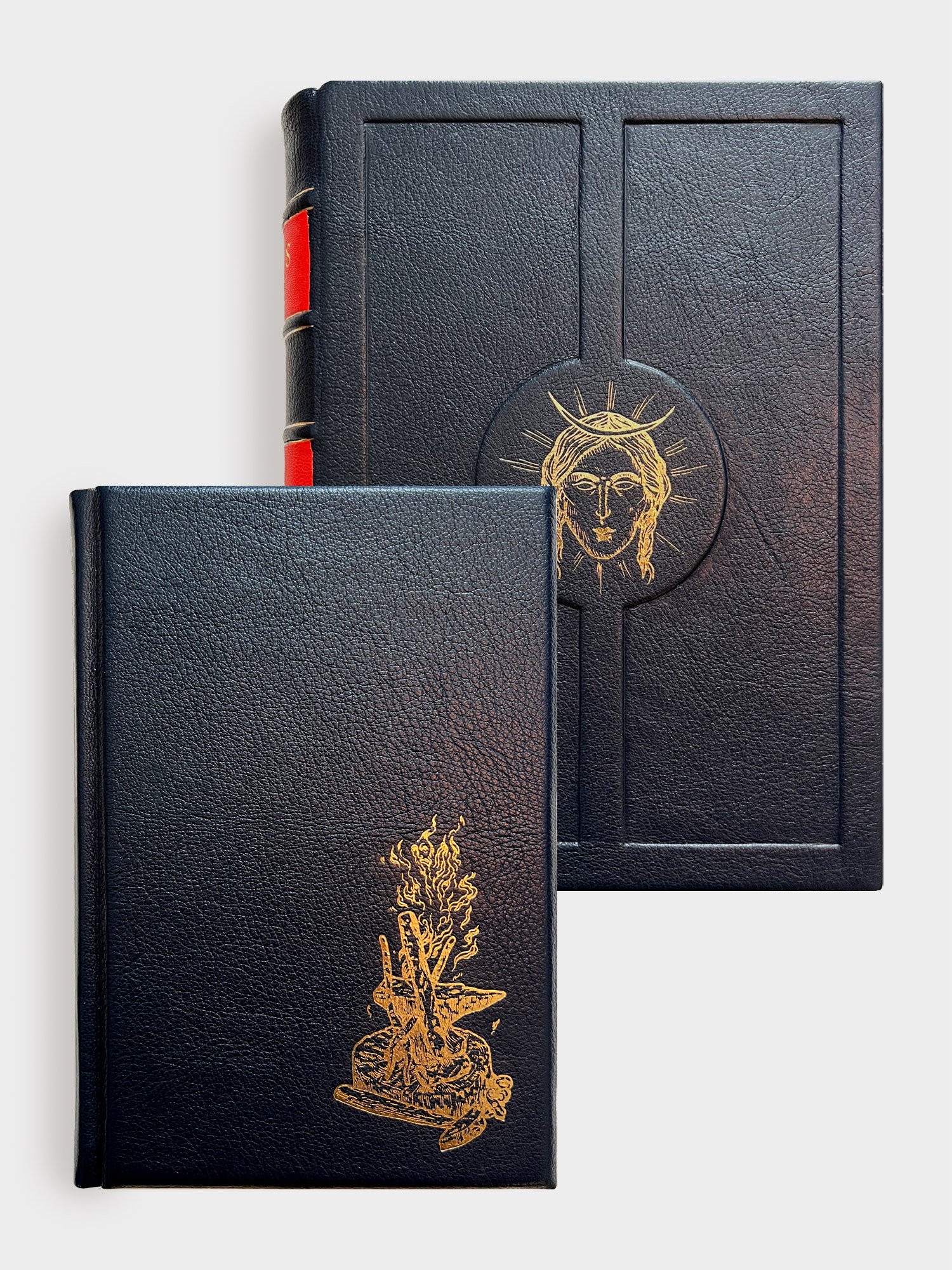
Tubelo’s Forge: A Gramarye of Robert Cochrane’s Early Years
by Shani Oates
Illustrations by Johnny Decker Miller
“The real Mystery is only uncovered by the individual, and cannot be told, but only pointed to.”
~Robert Cochrane
Robert Cochrane – a name synonymous with Traditional Craft – is perhaps one of its most controversial figures of the 20th century. Scores of articles, books, blogs and webpages claim much in his name, each a pastiche of the other, and though they are a testament to his popularity, they offer little substance regarding his work, and even less in terms of factual information. Addressing this plethora of misinformation and lack, this book, Tubelo’s Forge, composed by Shani Oates — the Maid and Matriarch of the Clan of Tubal Cain — brings much needed light and clarity to the work initiated by this most profound yet perplexing pellar and mystic of the Craft.
[read more below…]
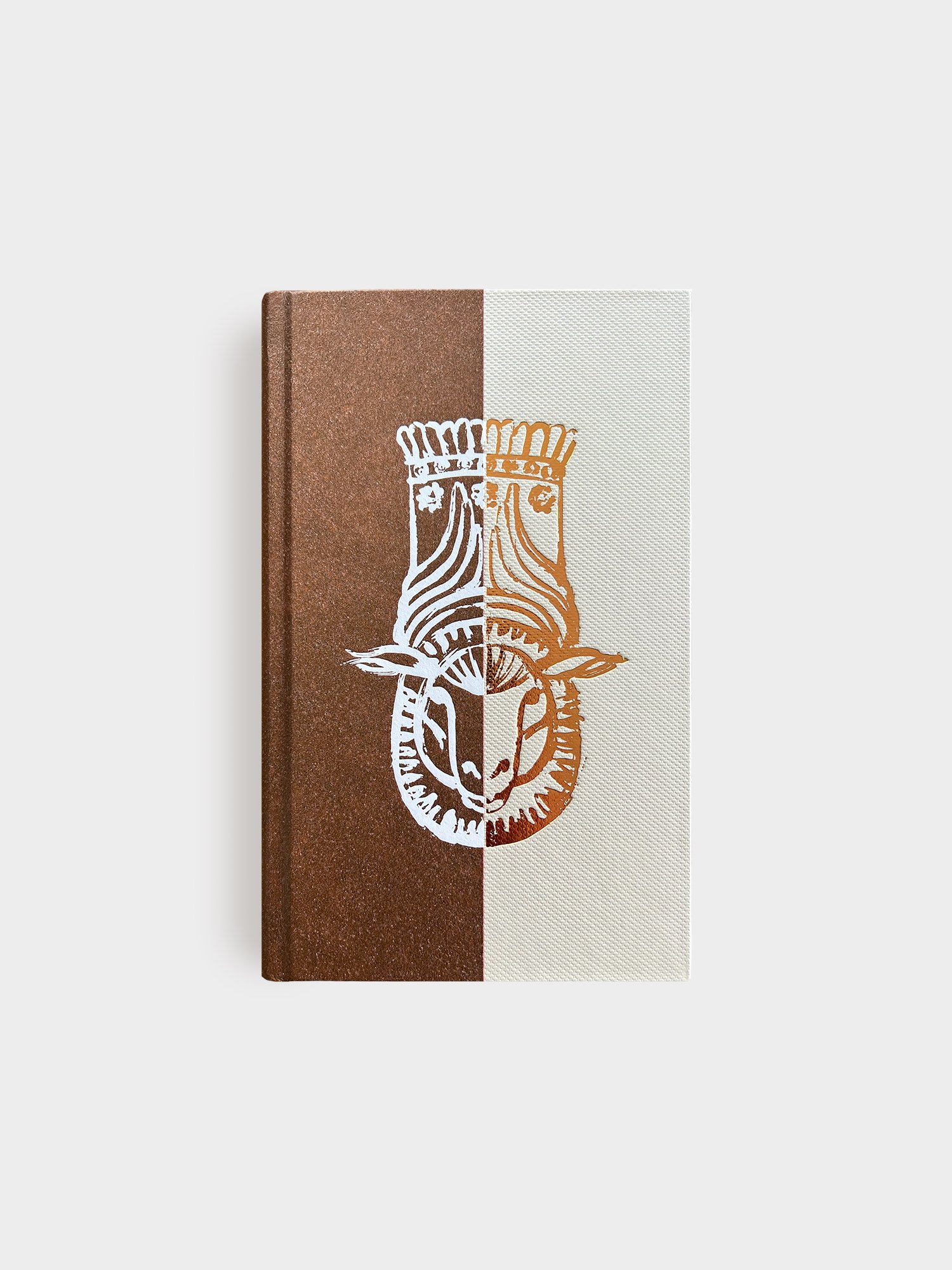
The Red Shepherd: Towards a New Image of Dumuzid
by Samuel David
Illustrations by Rowan E. Cassidy
Typeset, Layout, & Design by Joseph Uccello
Myth would inform us that Dumuzid was merely the effete, hapless shepherd god who invoked the anger of his wife, Inanna, and became little more than a footnote in myth.
Erotic poetry; liturgical texts and hymns; magical formulae, however, indicate something greater. In such texts, we find that Dumuzid is more than a mere pastoral deity standing guard over the sheepfold. He appears as a king; high priest; warrior; captain of the host and commander of chariots; a god who stands at the gates of Heaven, possesses a throne upon the Earth, and is seated beside Ereškigal, the great queen of the Underworld…
[read more below]
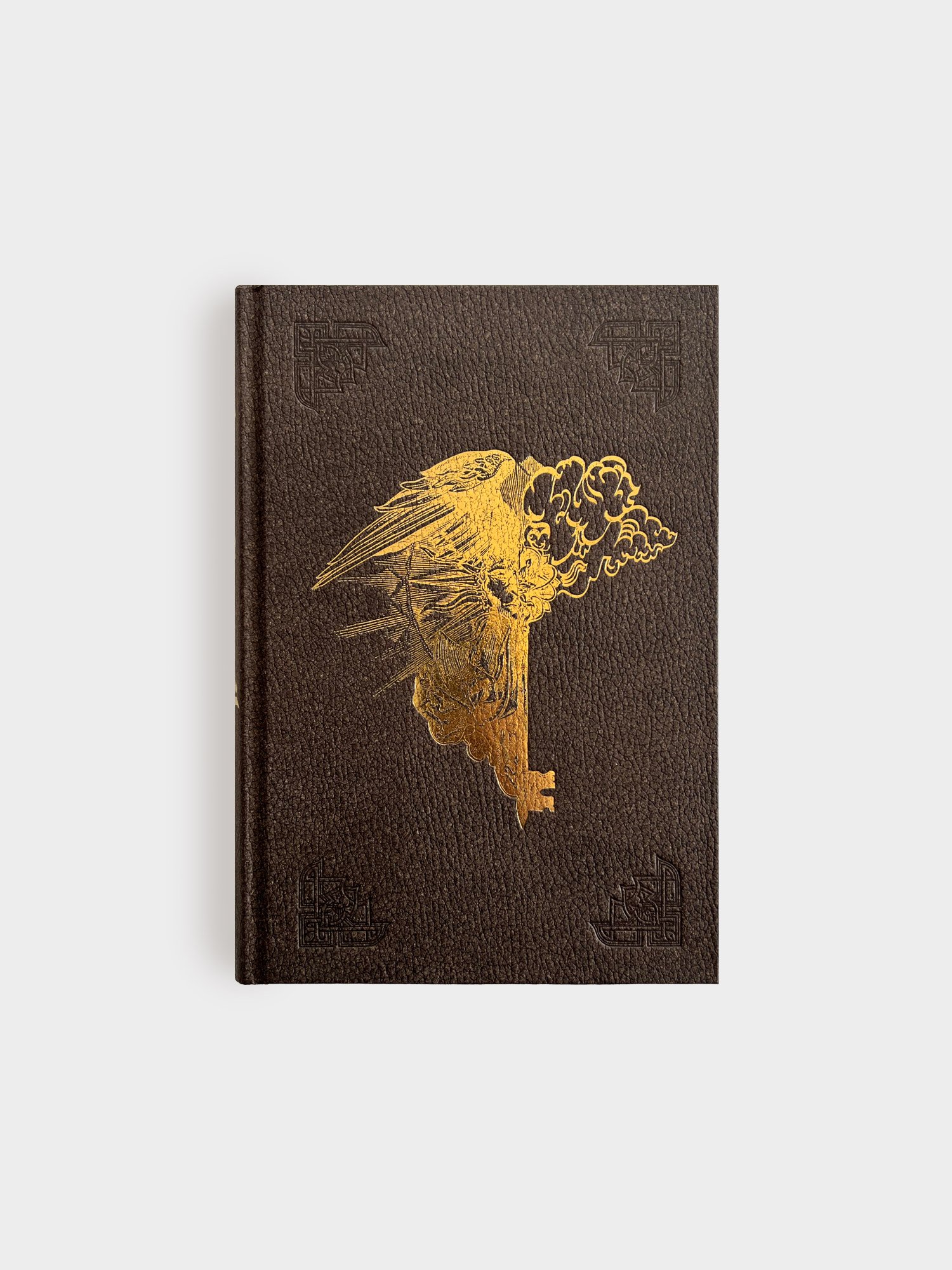
Semesilam: The Eternal Sun
by José Gabriel Alegría Sabogal
Typeset, Layout, & Design by Joseph Uccello
Semesilam: The Eternal Sun is a compilatory volume, gathering the artwork that José Gabriel Alegría Sabogal produced between 2012-2017. This ‘definitive anthology' includes the long out-of-print Handbook of Sacred Anatomy (Aeon Sophia Press, 2014) and A Second Nature (ASP, 2017), along with further, unpublished works from the same period and an extended photographic record of Sabogal’s work focusing on human skulls and bones…
[read more below…]
![On the Eleusinian and Bacchic Mysteries [PRE-ORDER]](https://images.squarespace-cdn.com/content/v1/63f0dc03f3010727a440d3a6/59bc0251-8d72-486f-9475-6f37a6ea5a2c/ON-THE-ELEUSIAN_01.jpg)
[PRE-ORDER - Shipping late Fall.]
On the Eleusinian and Bacchic Mysteries
Cauda Pavonis, vol. 2
By Thomas Taylor
Foreword by Guy Wyndham-Jones
Thomas Taylor’s On the Eleusinian and Bacchic Mysteries constitutes one of the most consummate and philosophically rigorous English expositions of the ancient Greek initiatory rites ever written. First published anonymously in 1790, this seminal dissertation unveils the inner meaning of the Eleusinian mysteries of Demeter and Persephone, and the Bacchic rites of Dionysus, revealing them as sublime allegories of the soul’s descent into generation and its arduous re-ascent to its divine source. In this new edition, featuring colour illustrations and a
Foreword by the contemporary philosopher and author Guy Wyndham-Jones, Taylor’s matchless analysis is faithfully restored and brought to bear upon the ancient mysteries once more.
[read more below]
![On Isis and Osiris [PRE-ORDER]](https://images.squarespace-cdn.com/content/v1/63f0dc03f3010727a440d3a6/79b8b95c-e60e-47ea-988a-9ac4b80554df/ON_ISIS_01.jpg)
[PRE-ORDER - Shipping late Fall.]
On Isis and Osiris
Cauda Pavonis, vol. 1
By Plutarch
Foreword by Prof. Panagiota Sarischouli
Plutarch’s On Isis and Osiris stands as the single most comprehensive and philosophically profound ancient account of the sacred Egyptian myth of Osiris’s betrayal, murder, and dismemberment by his brother Seth, his resurrection through the devoted magic of his sister-consort Isis, and the eventual triumph of their son Horus.
Written in the 2nd century by the Middle-Platonic Greek philosopher, biographer, and Delphic priest Plutarch, this treatise transforms scattered Egyptian traditions into a captivating narrative which explores the deeper meanings of divinity, immortality, sacred rites, and the eternal struggle between the forces of light and darkness.
[read more below]
![On Dreams [PRE-ORDER]](https://images.squarespace-cdn.com/content/v1/63f0dc03f3010727a440d3a6/247a3ac4-342f-4c01-83d9-4ccb1c5c998d/ON_DREAMS_01.jpg)
[PRE-ORDER - Shipping late Fall.]
On Dreams
Cauda Pavonis, vol. 3
By Synesius
Foreword by Dr. Kevin Wagner
Synesius of Cyrene’s On Dreams figures as one of the most riveting late-antique treatises on the nature and interpretation of dreams. Written in the early 5th century by the future bishop of Pentapolis and disciple of Hypatia, this work transcends a mere manual of oneiromancy to offer a rich Neoplatonic account of the soul and its vehicle, the Cosmos, and the imagination as the gnostic faculty through which divine knowledge may be attained in sleep.
In this new edition, accompanied by illuminating appendices from Cicero and Macrobius, together with A. Fitzgerald’s authoritative commentary, Synesius’ vision of dreams as a path to virtue and union with the divine is presented afresh for contemporary readers.
[read more below]
![Some Garden of Ash [FORTHCOMING]](https://images.squarespace-cdn.com/content/v1/63f0dc03f3010727a440d3a6/511aa70a-f242-4821-be56-4dabcfbe2407/SOME-GARDEN_temp.jpg)
Some Garden of Ash: Through Nine Gates of Undoing
by Evan Davies
Preface by Clint Marsh
Afterword, Illustrations, & Cut-Up Montage by Brian Cotnoir
Typesetting & Presentation by G. McCaughry
PRE-ORDERS: [TBD]
PRE-ORDERS for the Artisanal Edition: [TBD]
A restless, scattered search.
A mirror reflection of the modern western condition,
at once curious and critical, seething and wanting.
Some Garden of Ash is the debut from Evan Davies, long-time editor of Anathema Publishing.
Consisting of two distinct pieces – an introductory discourse exploring our relationship between spiritual identity, the attention economy, and capitalism’s all-pervasive influence; and its interdependent opposite, a body of ritual prose conceptualized through nine ‘gates’ of undoing – Some Garden of Ash is an esoteric meditation on the search for transcendence.
In an age of conspicuous consumption and media oversaturation, it is an abstract exchange of fear, desire, and meaning between the page and the reader: together, let us seek the infinite, and nothing at all.
[read more below…]
PRE-ORDERS
& FORTHCOMING
NEW ARRIVALS
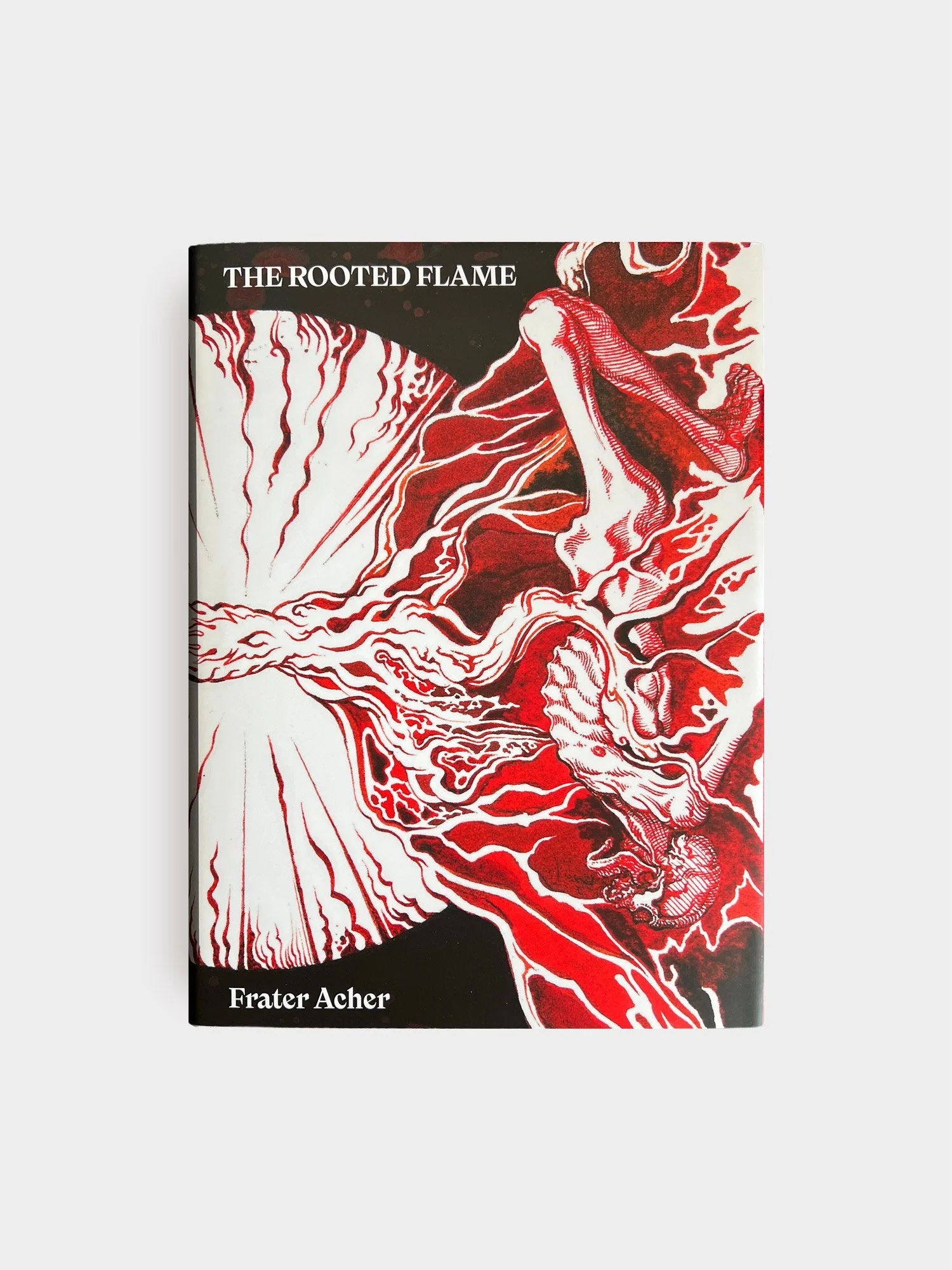
The Rooted Flame - A Goêtic Grimoire
By Frater Acher
Foreword by Harper Feist
Illustrated by José Gabriel Alegría Sagobal
The Rooted Flame appears as the culmination of many of Acher’s earlier works. It carries forward the heart-flame first kindled in Rosicrucian Magic and Holy Heretics. It continues the path begun in Holy Daimon, now stepping out into the open field of our familiar spirits. It is also a direct sequel to Ingenium: where that book prepares the inner self for spirit work, The Rooted Flame begins where those preparations are assumed to have been completed. Finally, it stands upon the broad shoulders of the entire Collectanea Goêtica, while aspiring to be his most technically explicit work yet on the practice of what he calls goêteia.
From the Introduction:
“What you hold in your hands is not a dark book, but a book for dark times. As I invite you to immerse yourself in the terror and tyranny of the Holocaust, in a world that seems to have come unhinged, even to the co-existence with parasites within your own bodymind – none of this is intended to shock or numb you beyond the pain you already live in. Rather, this book is intended as a field guide for times of tyranny. It teaches us how to resist without rage, and to burn without despair, but with deep roots, calm hands, and an open heart.”
— Frater Acher
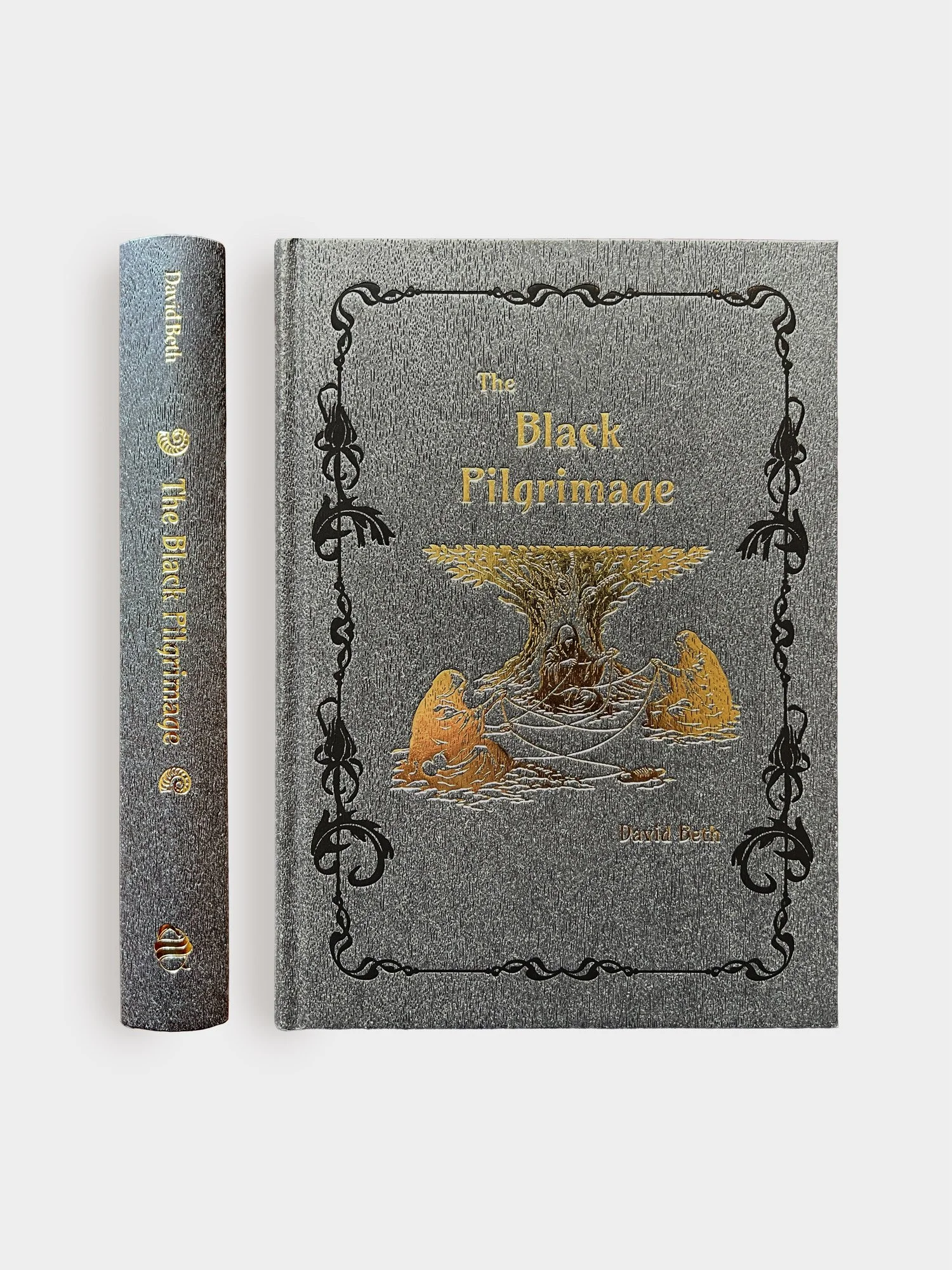
The Black Pilgrimage
By David Beth
The Black Pilgrimage by David Beth offers a comprehensive, inside view into the Primordial Way of the Kosmic Gnosis—its mysteries, cosmology, and operative art: a living initiatic tradition aimed at the re-calibration of mortal life into Kosmic allegiance, where the world meets the practitioner as a revelatory, answering reality and the human stands as a contested hearth for living powers. At its core is a rigorous pandaemonism / animism: the Kosmos as a communion of presences and currents, with hosts, daemons, gods, and the Dead.
“I cannot recommend Black Pilgrimage too highly; it is a defining and definitive text of modern esoteric thought and practice.”
— Peter Mark Adams
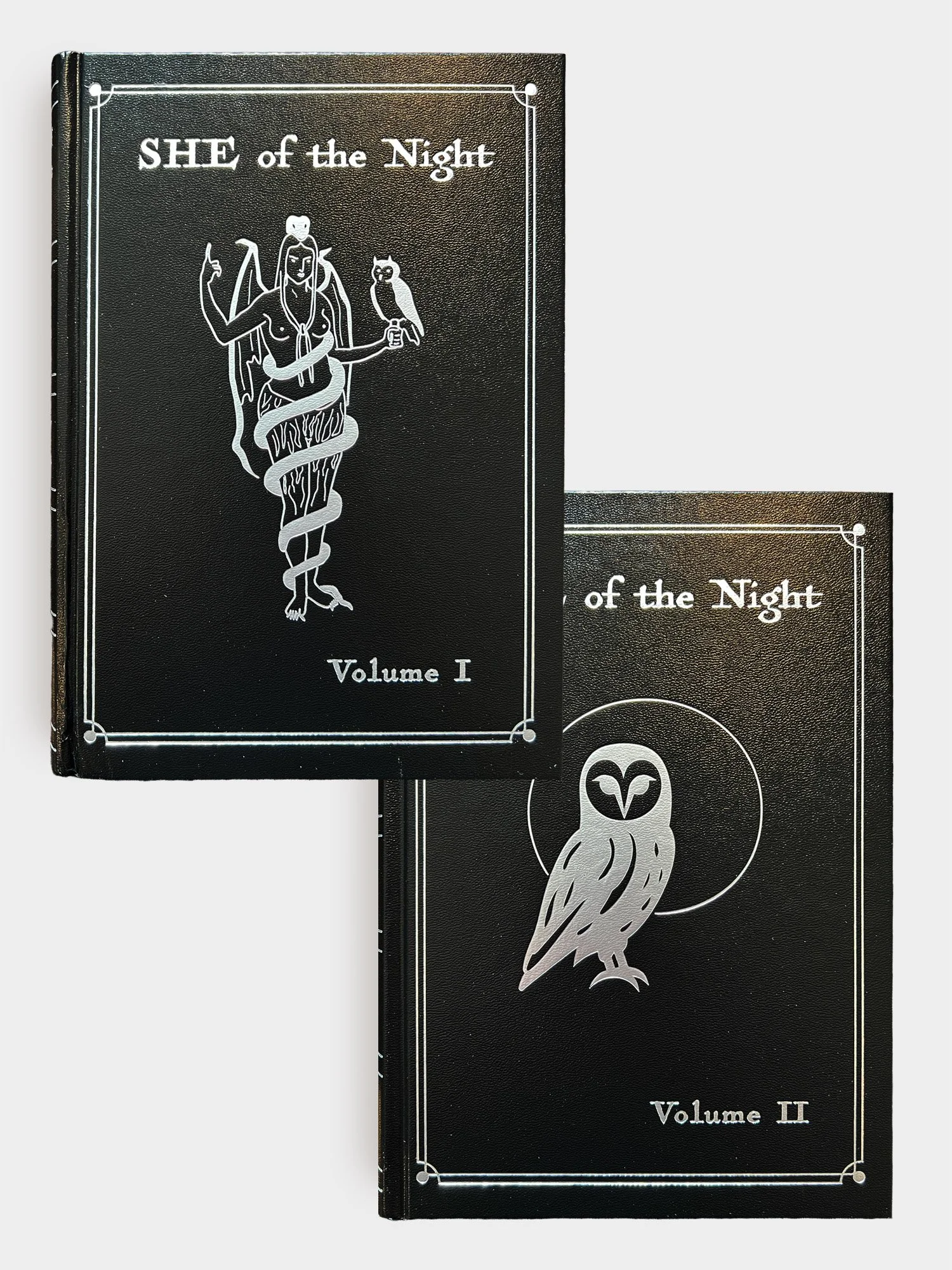
She of the Night (Two Volumes Set)
[2nd Edition]
By Idlu Lili Regulus
She of the Night by Idlu Lili Regulus stands as a monumental achievement—a true magnum opus born from over a decade of focused dedication and many more years of spiritual practice in honor of the Great Queen Lilith. She of the Night transcends the concept of a mere book; it is a profound grimoire—a comprehensive compendium of knowledge on Lilith, meticulously gathered and illuminated by a contemporary magus.
Due to the many requests we received for a reprint of She of the Night, its second, unchanged edition is now available. We have decided not to issue another Auric Edition for this print run. Instead, we are offering a more accessible Special Edition, presented in a sumptuous half-binding with marbled cover papers and housed in a custom black slipcase. Numbers are strictly limited across all formats, so we encourage you to reserve your copies as soon as possible.
[…read more…]
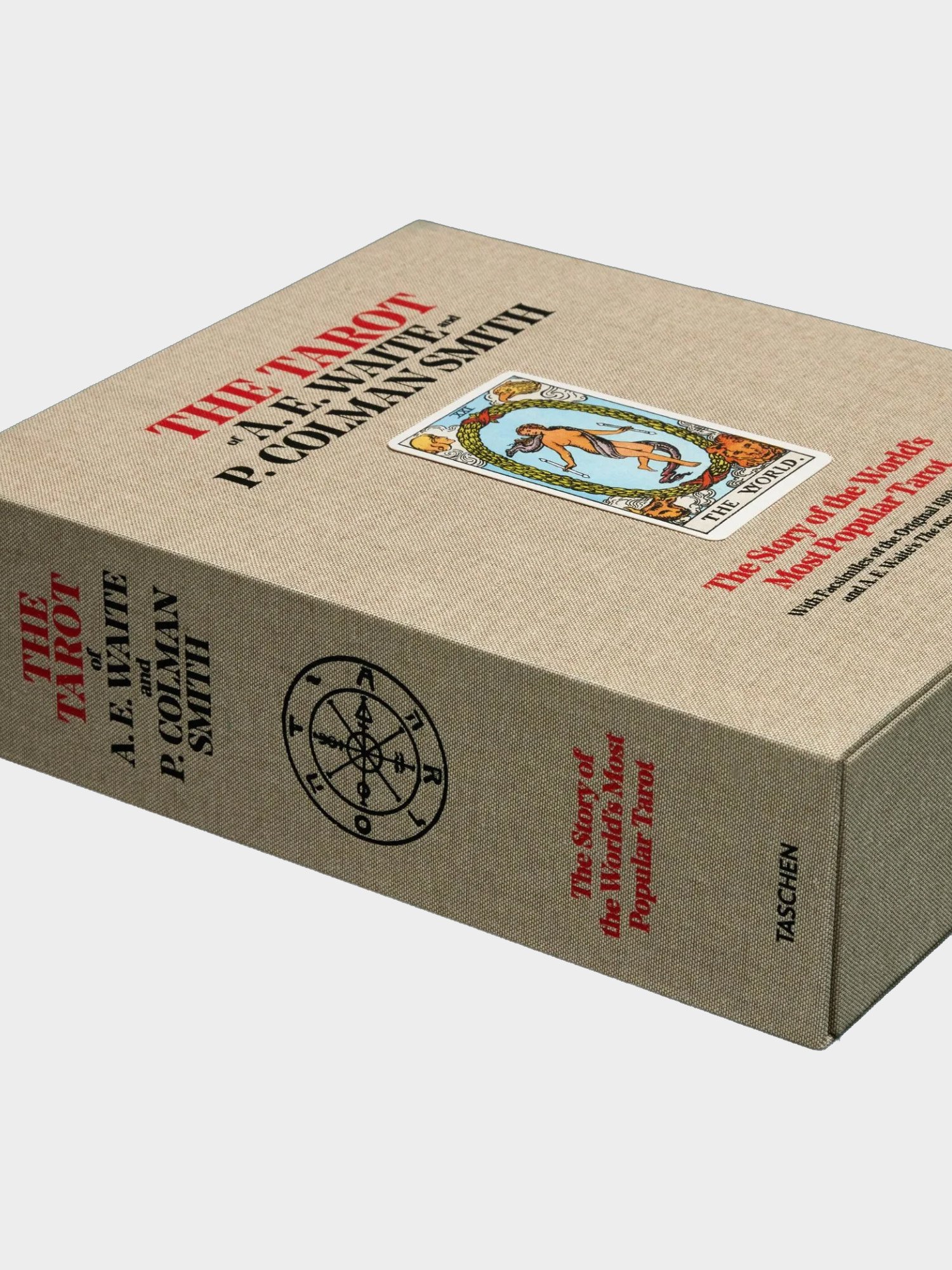
The Tarot of A. E. Waite and P. Colman Smith
MASSIVE Boxset incl. Card Deck & Two Books
by Johannes Fiebig (Editor), Robert A. Gilbert (Author), Mary K. Greer (Author), Rachel Pollack (Author)
A unique edition of bright texts, brilliant images, and historic reprints, this kit provides everything that both beginners and advanced Tarot users might need and want to read cards for themselves and to study and experience this cultural gem in all its beauty and significance.
The valuable collector’s box includes a complete deck of the Waite Smith Tarot cards and Waite’s famous companion book The Key to the Tarot. In this illustrated book, with texts and images compiled by Johannes Fiebig, the Tarot cards become psychological mirrors and signposts leading toward new answers and personal solutions. The fact that this works well can be attributed to certain advantages inherent to the Waite-Smith cards, and these points are illuminated in an essay by Rachel Pollack.
All 78 cards are presented individually and in detail. The explanatory texts provide several dimensions and levels of interpretation, including concrete practical tips. Further, the book offers a new feature: the quick check. This presents a concise hint regarding the meaning of each card in each possible position of all the spread patterns featured in the book.
When Arthur E. Waite and Pamela Colman Smith developed their Tarot deck in London in 1909, nobody could have predicted that it would have an overwhelming renaissance starting around 60 years later. What were the lives, works, and passions of these creators like? Pamela Colman Smith and Arthur E. Waite are brought vividly back to life in essays by Mary K. Greer and Robert A. Gilbert.
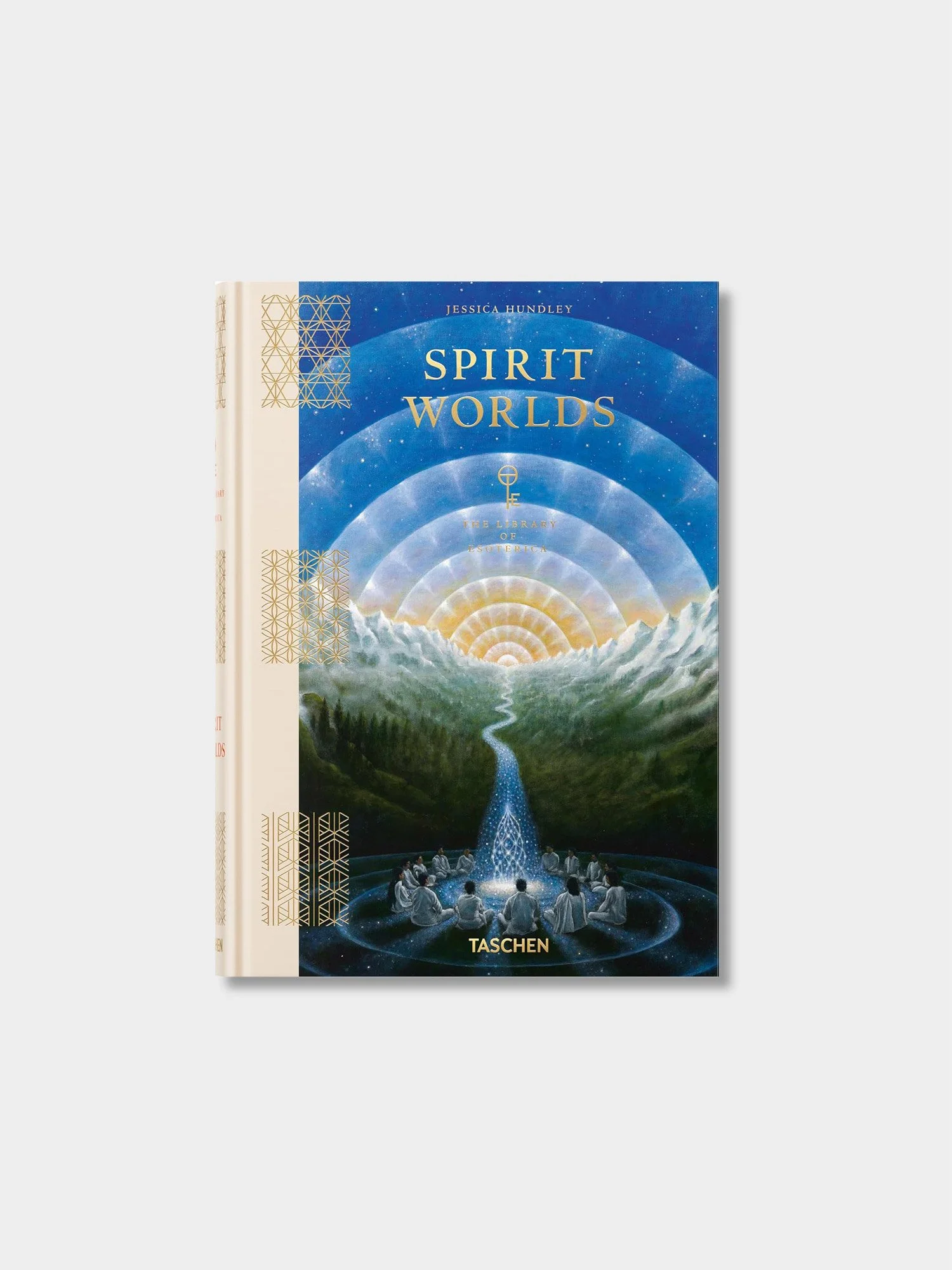
Sacred Sites
by Jessica Hundley (Editor & Author)
A voyage through mysterious and haunted lands.
Unearthing our complex beliefs around death, rebirth and resurrection, we explore the art, traditions and ancient stories of the afterlife. Through interviews with scholars and practicioners, insightful essays and over 400 works of visionary art, Spirit Worlds delves into the shadows of the supernatural, from dark domains of ghosts and demons to the light-filled lands of angels and celestial beings.
Across more than 500 pages, we celebrate the ways in which we connect with both our ancestors and with ourselves, as we worship, mythologize and honor our dead. We study the rites of death around the globe, highlighting the ancient monuments and sacred temples we build out of our sorrow. We showcase the altars we create and the communities we nurture as we share our grief with our gods. We dive into the rituals that connect us to those we’ve lost. And we decipher the messages communicated to us from the other worlds by mediums and prophets, through the elaborate séances of the Spiritualists, and in the storied words of oracles and fortunetellers bent at their crystal balls. And finally, we showcase artworks that that channel not only the muse, but the unknown, eloquent voices and visions from the other side.
In this expansive volume, we board the ferry across the storied river and enter the gloomy passages between lands, stepping across the threshold—to part the most sacred of veils.
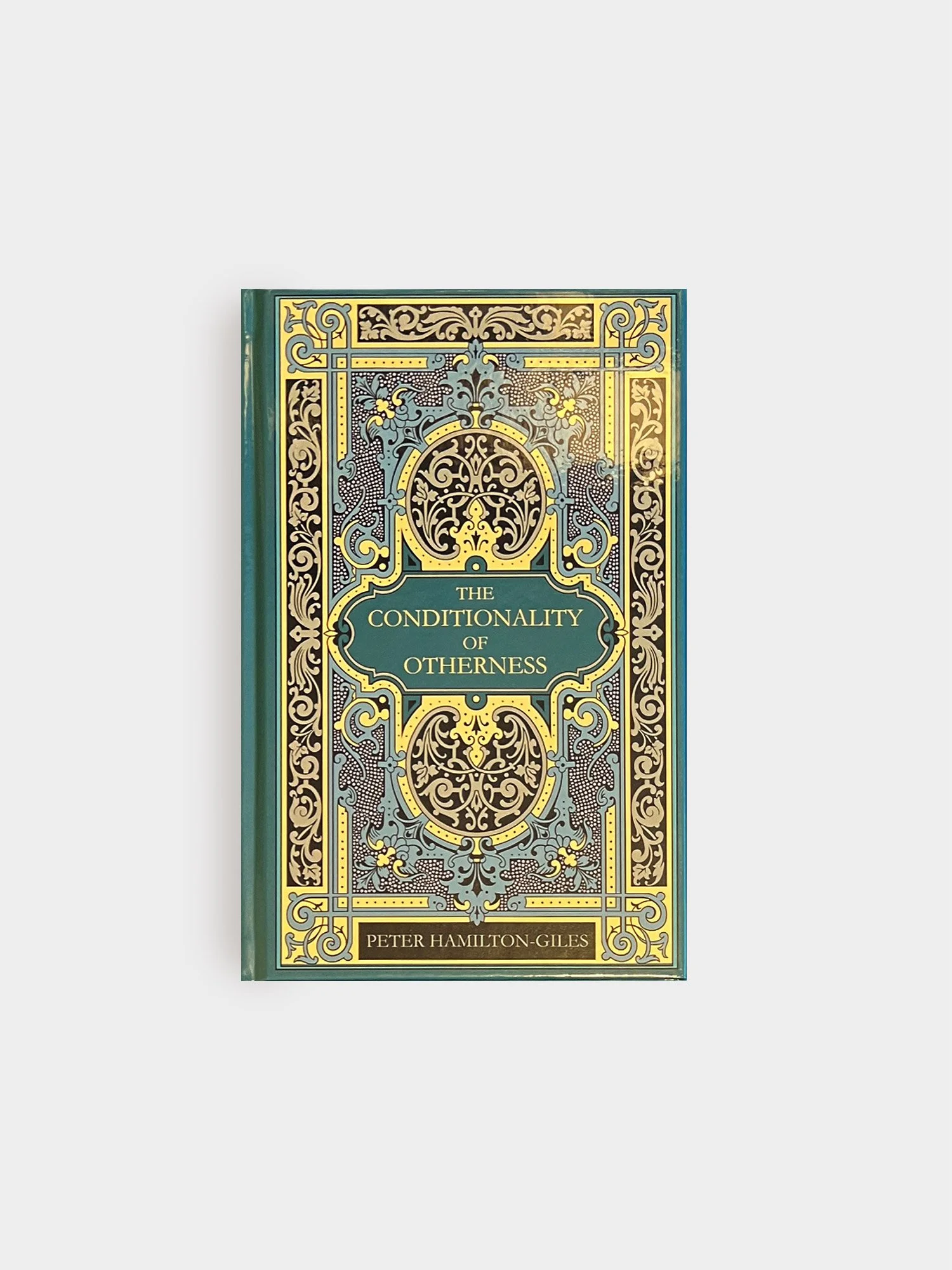
The Conditionality of Otherness
by Peter Hamilton-Giles
The Conditionality of Otherness addresses why the occcultist finds it so enticing to work with the inexplicable. To date, this is the most important book that this author has written, and the reason for this is found through the explanation for why we continue to have a fundamental relationship with those spirits who dwell as Other.
The author takes the reader to a place of contemplation where his experiences from working with Andrew Chumbley, a Nepali shaman and Haitian vodouisant who go to inform him and therefore the reader on how to grasp conditionality and therefore the 'current'.
By patiently conceiving worlds of possibility, Hamillton-Giles' The Conditionality of Otherness offers a critical step by step analysis for all of those who are interested in exploring the subjectivity of their position that informs their relationship with spirits and gods.
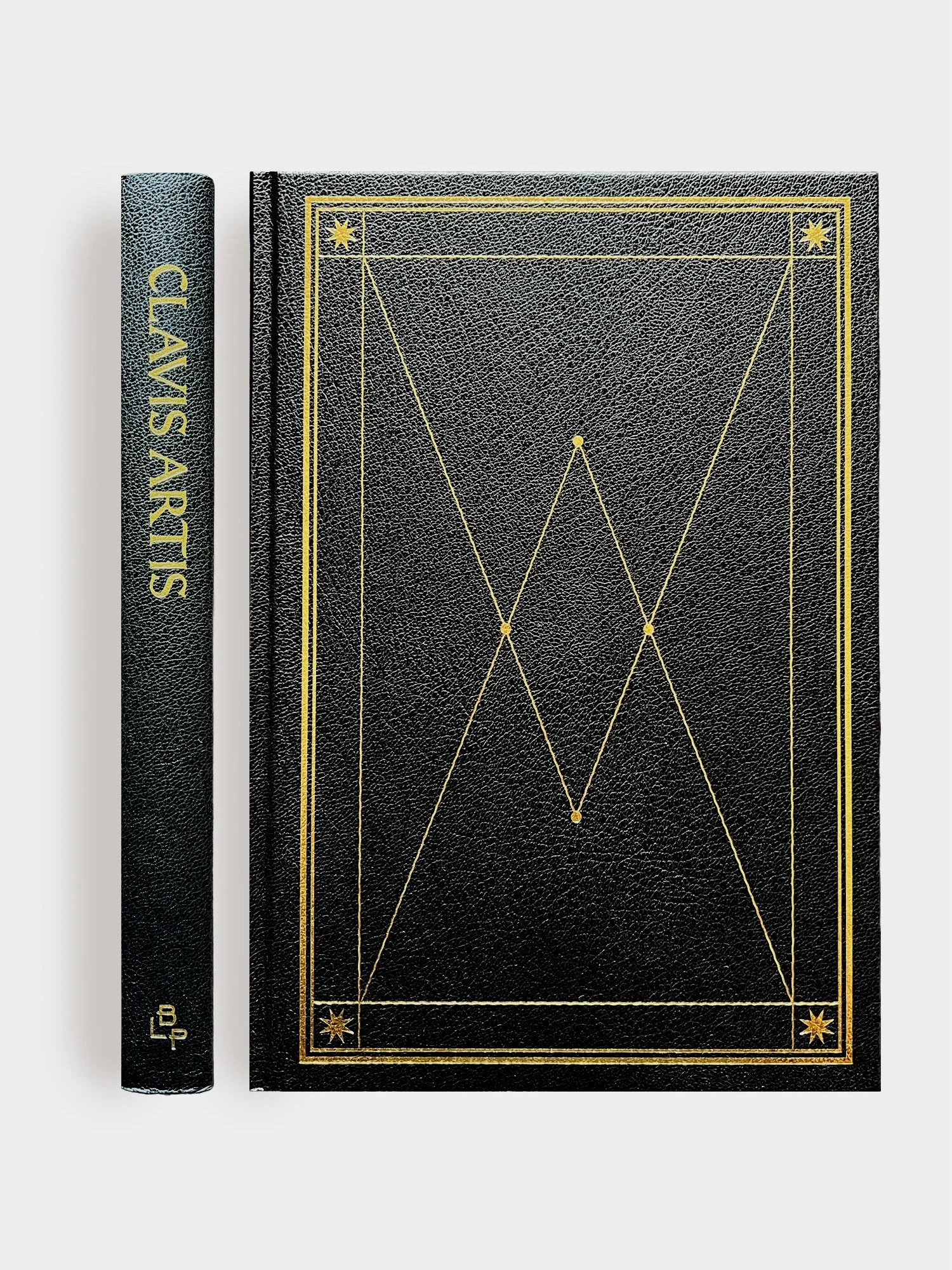
Translated, annotated, and introduced by Mark Kanak
Preface by Hunter Dukes
Clavis Artis is one of the most mysterious and visually striking works of the alchemical tradition. Long surrounded by speculation and fragmentary references, the text survives in only a handful of known sources and has remained largely inaccessible to modern readers.
This edition presents the first complete English translation and transcript of the rare 1738 Jena edition, accompanied by imagery from the celebrated Trieste manuscript. Alongside the translated text, the volumes explore the transmission, symbolism, and historical context of one of alchemy’s most enigmatic books.
Printed in Italy and produced in a large-format hardcover edition, Clavis Artis brings together careful scholarship, extensive image restoration, and meticulous design in a work created both for serious study and for the collector’s library.
[read more below]
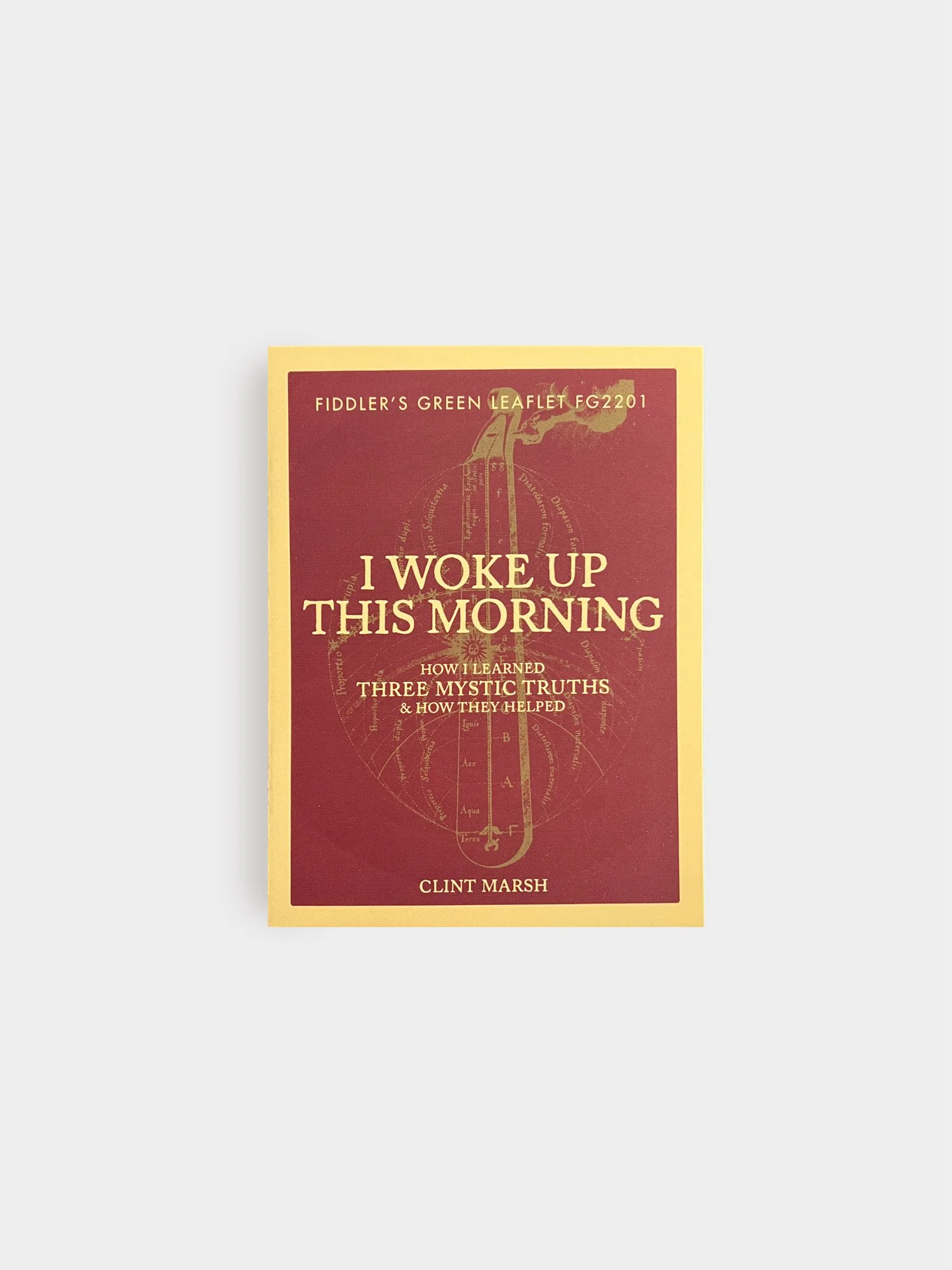
How I Learned Three Mystic Truths & How They Helped
A Fiddler’s Green Leaflet by Clint Marsh
At the Crossroads
My day job, my health, and my sanity seemed poised to pop next, along with my personal finances. Everything good in my life was collapsing around me, and I knew I had to do something to shore up what little remained intact.
The prudent move at the time would have been to make calls to a divorce lawyer, a real estate agent, and a job-hunting service. What, then, was I doing spending all my evenings and weekends in the garden shed behind the house?
Why, I was studying alchemy, of course.
Faced with a life-changing crisis, a young man seeks salvation in self-directed mystical study. The allegorical truths he finds in fantastical alchemical engravings, rich kabbalistic texts, and early American folk recordings shine a light on a path through the darkness and back toward better days.
In I Woke Up This Morning, Clint Marsh recounts his tumultuous passage through his first Saturn return. His experience grants him three foundational mystic lessons, presented here to help anyone going through hard times at any point in life.
Originally printed in the sixth issue of Fiddler's Green Peculiar Parish Magazine, Marsh's essay is illustrated with a selection of engravings from sixteenth- and seventeenth-century sources.
OUR MUSIC SELECTION
![BLIGHT - Temple of Wounds [CD]](https://images.squarespace-cdn.com/content/v1/63f0dc03f3010727a440d3a6/ec84a4b2-1ec5-46b8-b27c-2db5b606c751/BLIGHT-ToW_01.jpg)
[First Print CD, 2020. - Svart Records - SVART238CD]
Vocals & Words (heavily borrowed from (h)Aurorae), by G. McCaughry [CEO of Anathema Publishing Ltd.]
Music by P. Pelletier, C. Deschamps, and R. Lapalme.
Artworks (on real human skull) by José Gabriel Alegría Sabogal (Author & Illustrator of Semesilam and IAO: Ophite Iconography).
“Enter the Temple of Wounds, unleashed from the clandestine Canadians, BLIGHT. Rising out of obscurity to share their violent, radical, and illuminating vision, Blight’s nine song new album is a 52-minute exercise in galvanizing, and relentless Luciferian Black Metal. Temple of Wounds will find a home within the ashen hearts of listeners of luminaries such as Behemoth, Marduk, and Gehenna (think Adimiron Black era), while also embracing the contemporary, underground zeal of bands such as Bölzer, <code>, Cobalt, Light of the Morning Star, and Craft.
Yet the sound that Blight shapes out of chaos and calamity is uniquely their own: grand choirs and fiery chants pepper the band’s powerful and dynamic approach to Black Metal, where claustrophobic, menacing riffs threaten to suffocate, percussive elements merge violence with technological prowess, and vocals are delivered with a cathartic intensity.
Blight’s lyrical themes explore deep facets of inner alchemical transmutation, which lends their music substantial literary weight. Temple of Wounds is allied with a higher intelligence, creating a state-of-the-art sound-war of Black Metal that is at once fresh and familiar, primitive, and epic in scope.”
~Mat McNerney (PR for Svart, Hexvessel, Grave Pleasures, ex- Dødheimsgard, <code>, Beastmilk, The Deathtrip, etc.)
Tracklist:
1- Dar-Akh-Qayin (5:05)
2- Elsewhere & Elsewhen (5:38)
3- Kingship (5:40)
4- Before the Monolith (7:08)
5- A Violent Light (5:42)
6- The Aurous Nescience (5:04)
7- Palish-I (4:54)
8- Scrying the Iosis (5:58)
9- We Left Of Our Own Volition (6:12)
[9 songs, approx. 52 minutes]
Additional Information:
• Recording and mixing by Dominic Grimard (The Last Felony, Ion Dissonance) at Blackboard Studio (2019).
• Vocals recorded at The Grid Studio (Montreal) with help and assistance from Chris Donaldson (Cryptopsy).
• Drums recorded at Studio Madame Wood.
[scroll down to preview the album]
![SUBLIMATIO MORTIS - Dolar Qui Animum Sublevat [TAPE]](https://images.squarespace-cdn.com/content/v1/63f0dc03f3010727a440d3a6/a283618a-3bc5-4474-b031-1a2b911dcd98/SUBLIMATIO_01.jpg)
[Limited edition Cassette Tape EP.]
"The path to illumination is seldom one of comfort and ease, for arduous is the pilgrimage through the wastelands of the interior desert."
Brand New EP of Sublimatio Mortis' monastic ritualism and contemplative soundscape is now available!
Tracklist:
1- Clavis Mysteriorum (30:14 min)
Additional Information:
Limited to 50 copies.
Released through Scarlet Kross Collective.
A Bandcamp redeem-code will be forwarded via email to each customer upon request.
[scroll down to preview the album]
![PRIMAEVUS - An Eldritch Odyssey [Tape]](https://images.squarespace-cdn.com/content/v1/63f0dc03f3010727a440d3a6/1718639382158-QGT009LOXTYZIV9APRLM/Primaevus_Tape_01.jpg)
Label: Small Offerings Records
Format: Cassette tape + Digital Code for Mp3 Download inside.
Tracklist:
1. A Dream... 03:24
2. Tainted Within 05:06
3. Into the Abyss 07:49
4. The Oneiric Invocation 09:02
5. ...within a Dream 04:44
The arcane hour has dawned...
The spirits of the woods have gathered, gyrating feverishly to the eldritch hymns reverberating across the Mountain Home. And now, it's time for the denizens of the Earthly realm to behold and immerse themselves in these tunes.
In the Autumn of MMXXI, the mystical landscapes of the Western Himalayas in Northern India bore witness to the birth of PRIMAEVUS, Indian's first Dark Folk entity comprising of Ankit Sinha (vocals, lyrics) and Harul Vinay (guitars, composition). Ankit and Harul joined forces to create somber, captivating music inspired by the grandeur of the mountains, the nature, and the eerie history of the monuments in the region, juxtaposed by their studies in mysticism and the cosmic horror masterpieces penned by the likes of HP Lovecraft, Edgar Allan Poe, and Clark Ashton Smith. Now, they proudly unveil their debut album, titled "An Eldritch Odyssey". Composed during the isolating chaos of the COVID-19 pandemic, the music reflects a yearning for connection and a search for meaning in a world shrouded in darkness. Three years later, as the world faces new struggles, this album emerges as a beacon of hope.
"An Eldritch Odyssey" is a meditative journey that features Harul's sombre, enrapturing guitar work juxtaposed with Ankit's rich baritone vocals. Taking the intensity to another level is the masterful works of Alex Pfister and Edward Longo. Alex's amazing talent is on full display here with him handling the percussions and playing the Native American Double-flute and the Irish Bass Whistle. Edward has added a touch of grace with his Pipe Organ performance. The artwork is yet again done by the amazing Vasantaghara.
It's a multi-sensory experience, blending music, poetry, and visual art into a wholesome artistic offering. This immersive journey into human consciousness, liminal dream states, and mysticism aims to uplift and empower kindred spirits, offering solace in these dark times. Hauntingly beautiful and introspective, this album is an ode to the vast emptiness, the solace of nature, and humanity's enduring connection to both. Ankit crafts evocative verses, while Elurka contributes a poem that deepens the thematic exploration.
Hailing from an extreme metal background, both Ankit and Harul wanted to transpose the sensibilities of doom and black metal to the acoustic realm, creating music that would transport the listener to a phantasmagorical world. Ankit's deep baritone vocals blend with Harul's somber guitar passages, evoking a hypnotic, trance-like sound that would appeal to both listeners of post-industrial, gothic/ darkwave music and lovers of doom and black metal. With this record, the band envisions to create a deep, emotive bond with listeners and provide them with a cathartic experience aimed at healing and nurturing their spirits with music that is not meant to be consumed, but rather contemplated upon.
Recommended for fans of — Rome, Empyrium, Agalloch, Of The Wand & The Moon, Opeth, etc.
"For we are rooted here,
Deep beneath this Earth."
Dedicated to the loving memory of Avinesh Lata Behl
Known to her loved ones as “Didu”
(August 16, 1948 - December 10, 2023)
AMOR VINCIT OMNIA
[scroll down to preview the album]
LATEST ARTEFACTS
Important Update for U.S. Orders: As of Aug 22, a new 50% U.S. import tariff applies to Jewelry. (That being said, the 50% tariffs will be applied to production costs and not retail price, thus lowering the extra amount to pay for the customer). Books remain exempt. An invoice for the surcharge will be sent before shipping. Orders ship once paid.
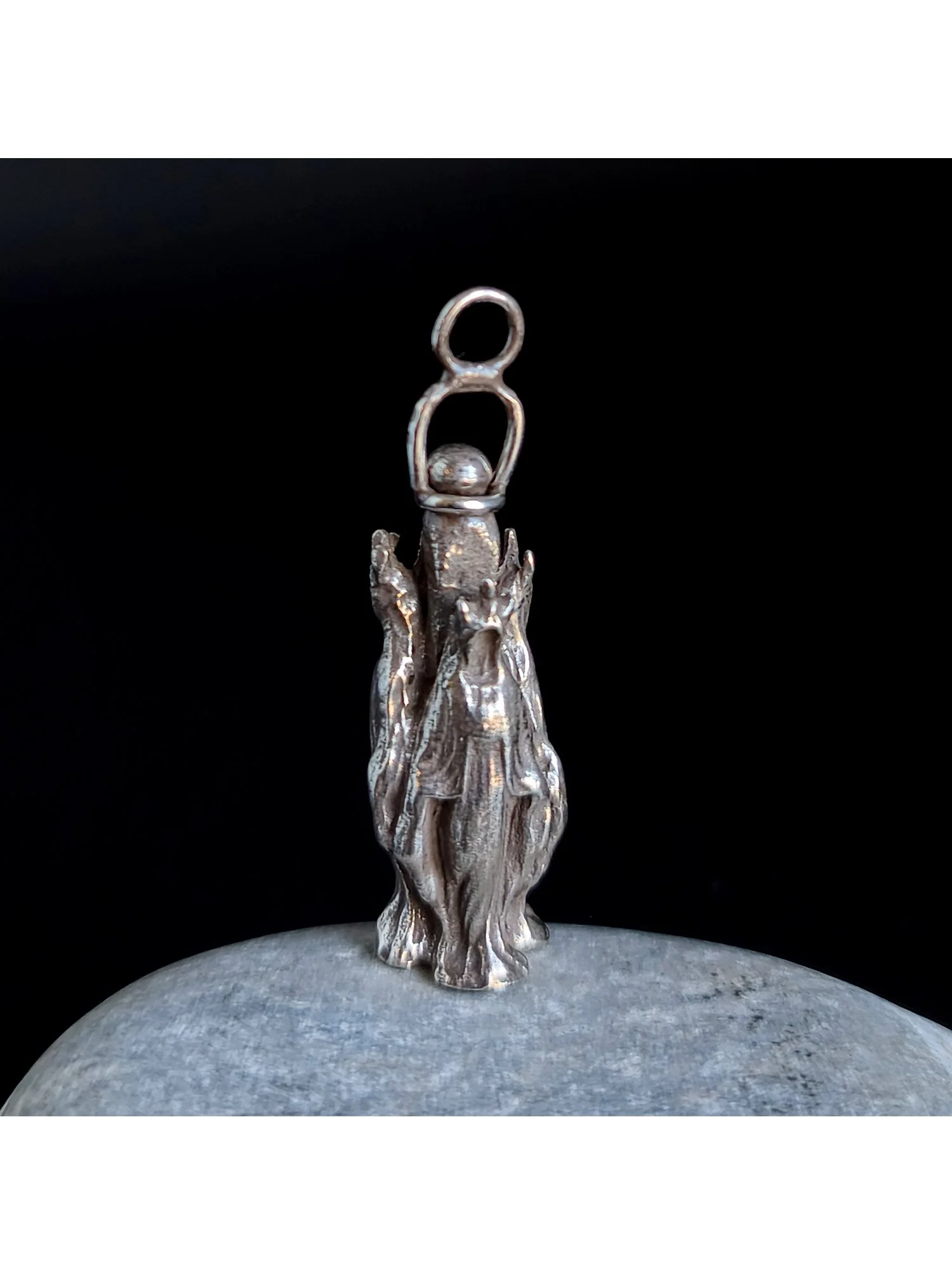
Limited Edition (4): Hekate Trimophis (Rotary Pendant - Spinning on its axis)
By AzK Talismanic Jewelry
Hekate, Soul of the World.
Here is a piece created to honour Hekate. In Her trimorphic form, surrounding the four-sided pillar, She is all-encompassing.
There would be far too many things to say about Hekate. For the Hermetic tradition, She is the Soul of the World; for the Greeks, She is associated with the sea, the earth, and the sky. She is Liminal Space itself, the goddess of witchcraft and sorcery, and a powerful presence frequently invoked throughout the PGM.
I designed this piece as a wearable altar and effigy, a small sacred object meant to be carried close to the body. The pendant is designed to rotate freely around the pillar, allowing each side to take its place in turn. No face is meant to prevail over another; each is part of the whole, just as Hekate Herself encompasses multiple aspects without being reduced to any single one.
The piece is therefore not meant to represent a fixed image of the goddess, but rather to evoke Her presence through movement, multiplicity, and the perpetual crossing of thresholds.
*Size: 1 ½ inch | Weight: 13.50g. Sterling Silver (925).
Every piece of jewelry is made in France (Europe).
Important Update for U.S. Orders: As of Aug 22, a new 50% U.S. import tariff applies to Jewelry. (That being said, the 50% tariffs will be applied to production costs and not retail price, thus lowering the extra amount to pay for the customer). Books remain exempt. An invoice for the surcharge will be sent before shipping. Orders ship once paid.
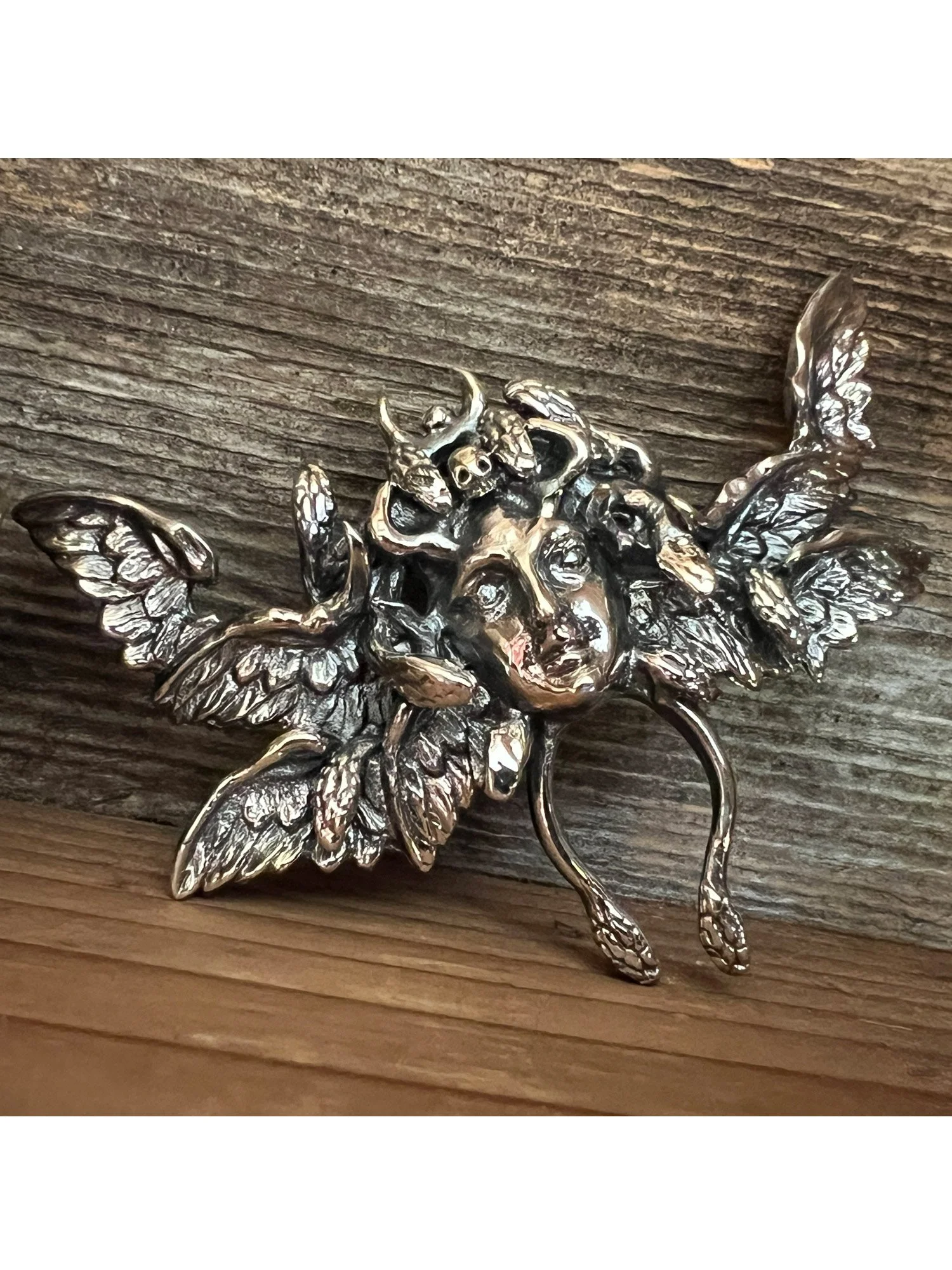
Limited Edition (3): Medusa (Brooch)
By AzK Talismanic Jewelry
This substantial piece, cast in 925 sterling silver, depicts Medusa in a form that is both ancient and deeply primal. Yet this is not the severed and lifeless head so often portrayed in classical representations. Here, Medusa is very much alive. Her gaze remains powerful, her presence fierce, and her serpentine nature fully awakened.
In this interpretation, Medusa’s living head becomes a manifestation of the primordial dragoness, an ancient mother and ancestral force, sovereign of dragons and serpents. She embodies the untamed, chthonic power that lies beneath the ordered world: a creature of thresholds, protection, danger, and transformation.
The piece carries a dual nature. It is at once a protective emblem and a threatening presence, intended not merely to adorn, but to stand guard.
Designed to be worn during ceremonial and ritual practices, this heavy silver piece can be used to fasten a cloak, cape, or other ritual garment. Worn, it becomes more than a clasp: it acts as a guardian and a visible declaration of power, marking both the wearer and the garment as belonging to a sacred and liminal space.
A piece for those who wish to carry the serpentine, feminine, and primordial power with them...
*Size: 3 x 2 ¼ inch | Weight: 35g. Sterling Silver (925).
Every piece of jewelry is made in France (Europe).
Important Update for U.S. Orders: As of Aug 22, a new 50% U.S. import tariff applies to Jewelry. (That being said, the 50% tariffs will be applied to production costs and not retail price, thus lowering the extra amount to pay for the customer). Books remain exempt. An invoice for the surcharge will be sent before shipping. Orders ship once paid.
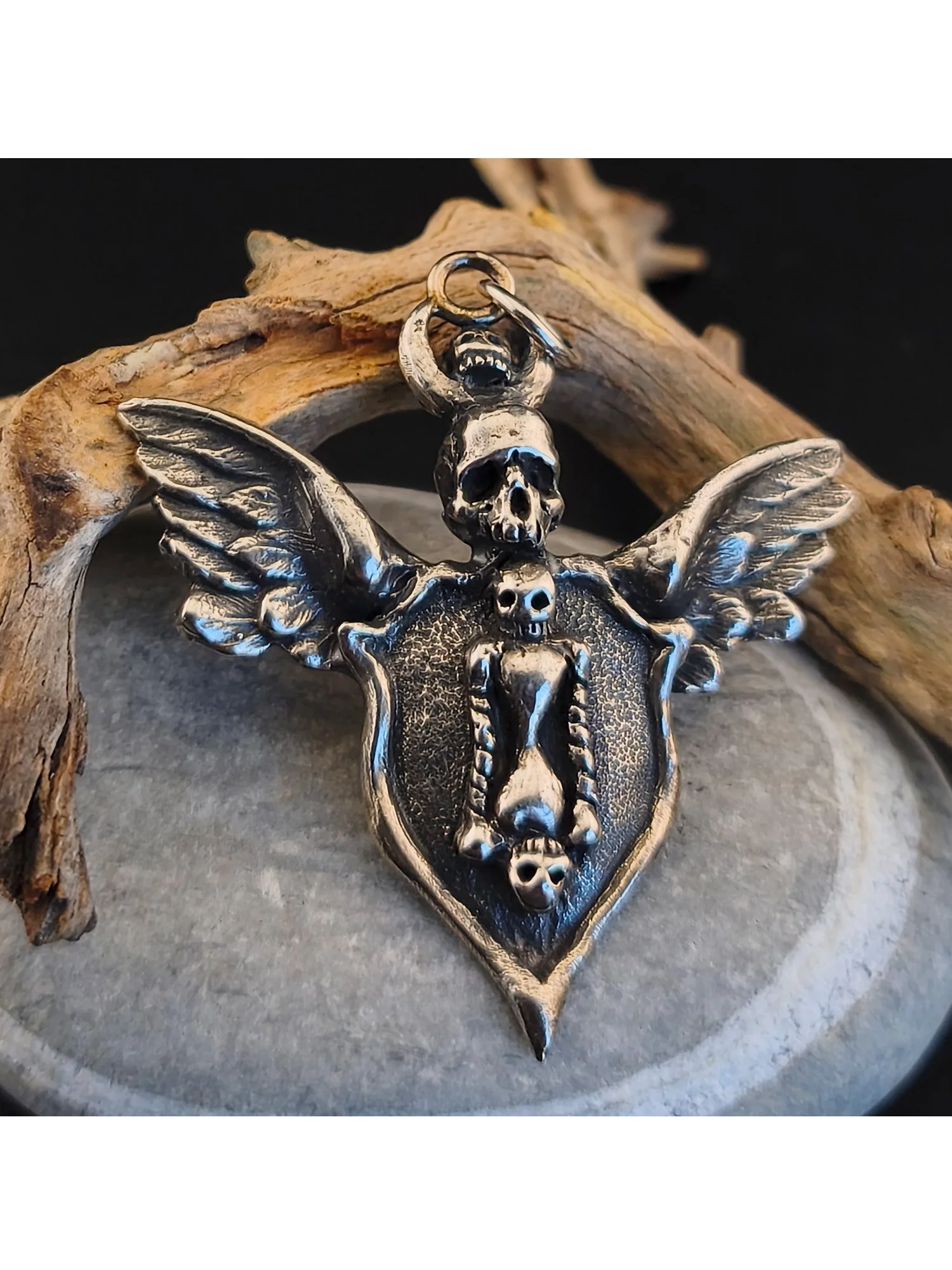
Limited Edition (4): Memento Mori (Pendant)
By AzK Talismanic Jewelry
Memento mori, that old adage…
For us, witches and mystics, it is both a reality, for we work with Death, and initiation itself is a death before death, and, at the same time, one of the ultimate aims of the spiritual quest is to transcend death through access to immortality. Yet Death may come at any moment. The only thing we are given is a certain amount of time.
This is what this silver pendant represents: a shield upon which an hourglass slowly runs its course, adorned with wings, the wings of the Angel of Death.
The hourglass is a reminder that time is never ours to possess. It passes through us, grain by grain, while the wings of Death remain ever-present, waiting beyond the threshold.
To wear it is therefore to carry a simple and ancient truth close to the body: our time is limited, Death is inevitable, and what we choose to do with the time given to us is part of the mystery.
*Size: 1 ¾ x 1 ¾ inch | Weight: 12.80g. Sterling Silver (925).
Every piece of jewelry is made in France (Europe).

Important Update for U.S. Orders: As of Aug 22, a new 50% U.S. import tariff applies to Jewelry. (That being said, the 50% tariffs will be applied to production costs and not retail price, thus lowering the extra amount to pay for the customer). Books remain exempt. An invoice for the surcharge will be sent before shipping. Orders ship once paid.
Limited Edition (5): Azazel (Pendant)
By AzK Talismanic Jewelry
This pendant (as a shield or coat of arms) features on one side the Goat head, symbol of Azazel, and on the other side the sigil of Saturn, which is also associated to Azazel.
Azazel is a complexe figure. A demon of the desert, a fallen angel in the book of Enoch who taught humankind the secret of the metals and jewelry. Associated with Mars and the sefirah Gevurah. Sometime he is associated with the devil himself, the black goat of the Sabbat and for the Yezidis, Azazel is yet another name of Melek-Taus; the Peacock Angel.
This pendant is my tribute the Master of the Black Forge in which burn the flames of the stars…
*20 inches with the chain. Sterling Silver (925).
Every piece of jewelry is made in France (Europe).
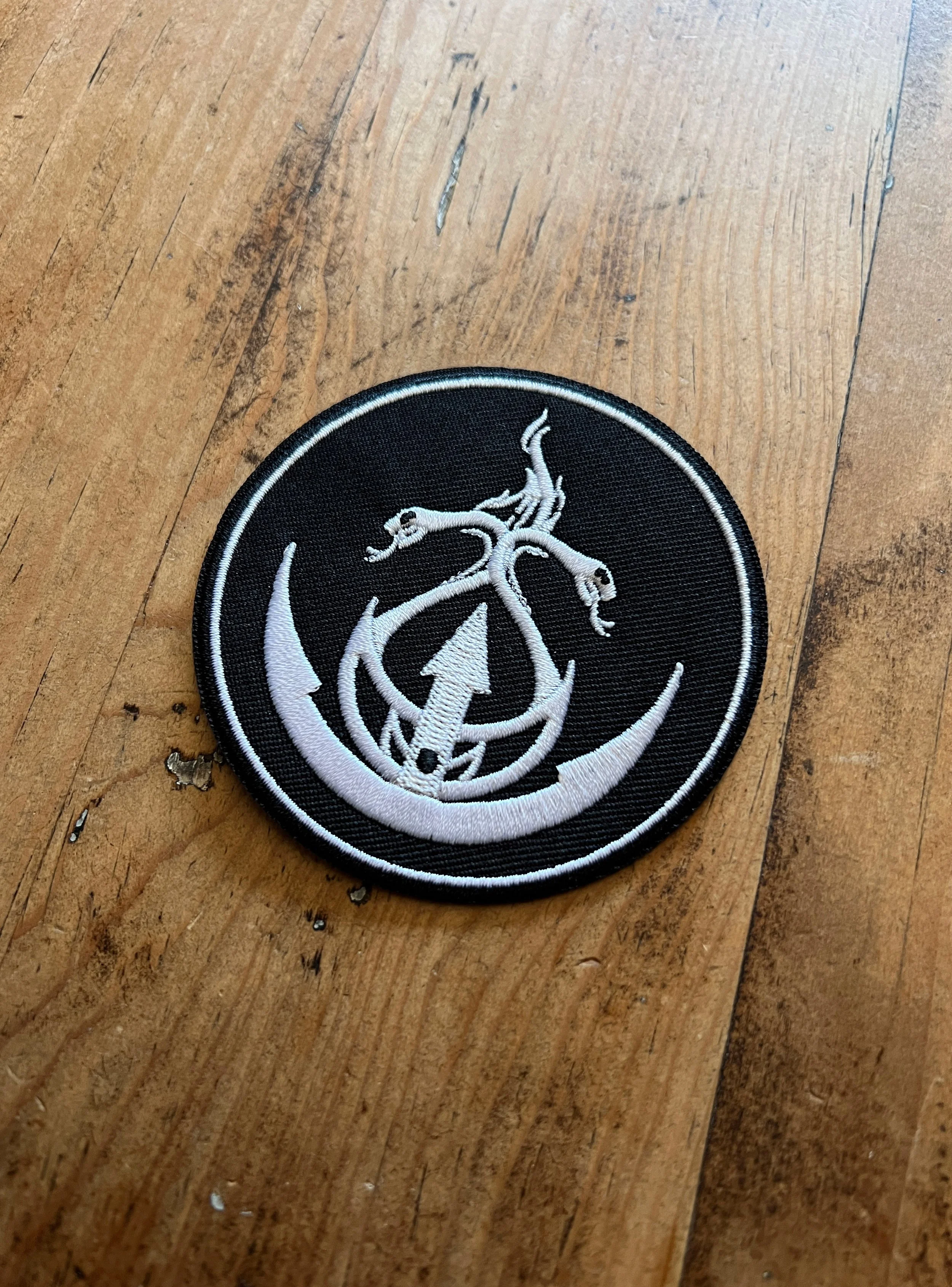
Anathema Publishing logo/symbol — Embroidered Patch
Description:
50% - Mostly text, Polyester Blend Twill, Thread (1-9 colors), Standard Thread, Iron-on, Embroidered Border
Dimensions:3” x 3” (7.6 cm × 7.6 cm)
Limited (for now) at: 50
![IAO [Collector's Ed.]: Back Cover (Embossing Copper Die)](https://images.squarespace-cdn.com/content/v1/63f0dc03f3010727a440d3a6/2f59ead3-b387-4c0a-bed4-21e495c697c9/IAO-COL---Back-DIE.jpg)
Important Update for U.S. Orders: As of Feb 24, a new 15% U.S. import tariff applies to stamping dies. Books remain exempt. An invoice for the surcharge will be sent before shipping. Orders ship once paid.
IAO: Ophite Iconography by Jose Gabriel Alegria Sabogal [Collector's Ed.]: Back Cover (Embossing Copper Die)
Description:
Unique piece of solid, heavy, and etched copper used for deep debossing.
Dimensions: 4 cm X 8.5 cm (1.6” x 3.3”)
This piece was used to stamp the Back Cover of IAO: Ophite Iconography Collector’s Hardcover edition 2022 (ltd. to 412 copies total.). Illustration by Jose Gabriel Alegría Sabogal.
For collectors of independent occult publishers’ memorabilia, this unique artifact from the Anathema Publishing's past is a rare piece of its legacy. An exceptional addition to any individual collection of curios devoted to the esoteric, the odd, from the world of high-quality bookmaking.
Comes with a signed certificate of authenticity.
PS: This item, sold individually, does not include a copy of the book itself.
For more information about this book, please refer to the title’s listing.
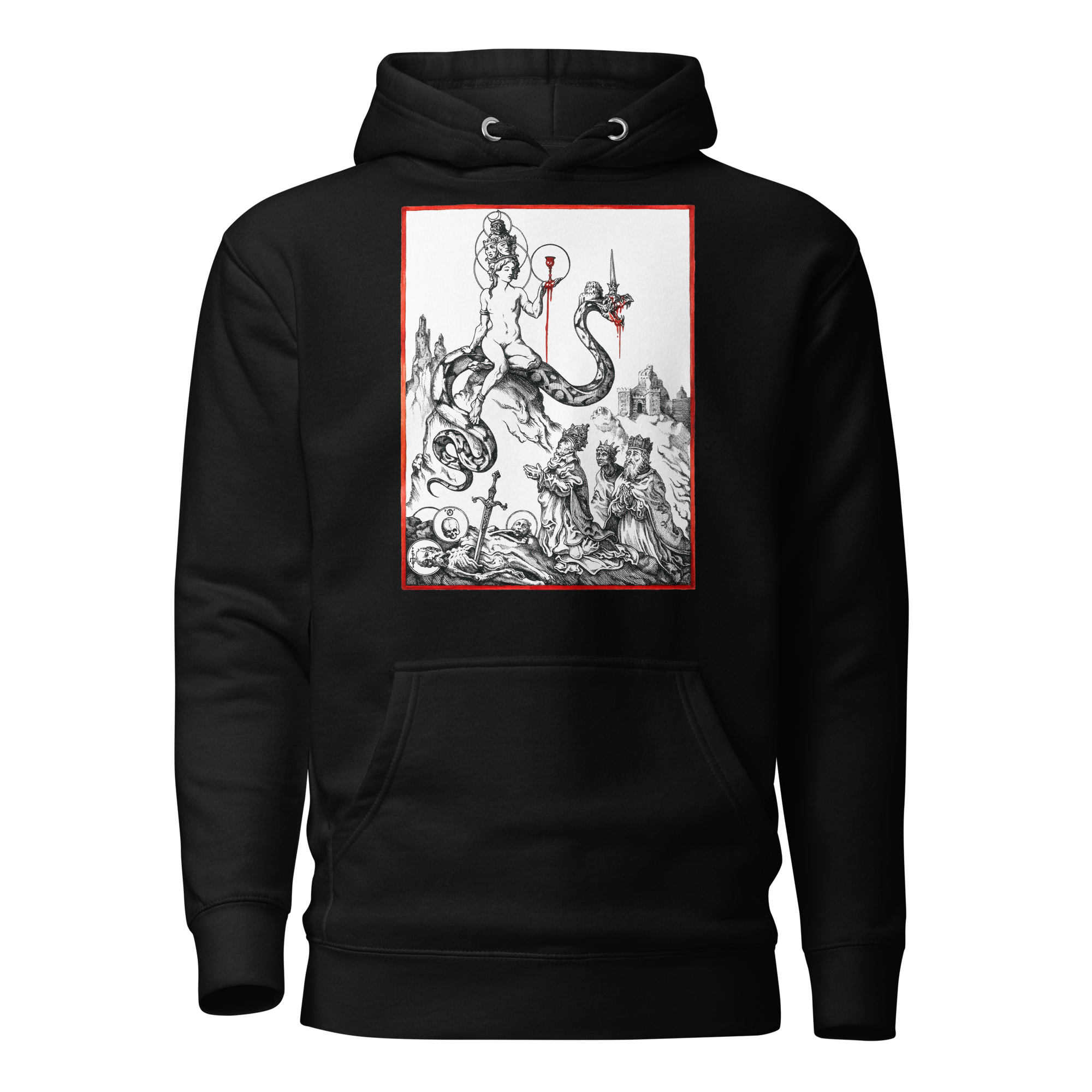
An ephemeral collaboration between Anathema Publishing Ltd. & José Gabriel Alegría Sabogal.
(Officially licensed artwork © Anathema Publishing Ltd. & José Gabriel Alegría Sabogal.)
• 100% cotton face
• 65% ring-spun cotton, 35% polyester
• Front pouch pocket
• Self-fabric patch on the back
• Matching flat drawstrings
• 3-panel hood
• Blank product sourced from Pakistan
Disclaimer: This hoodie runs small. For the perfect fit, we recommend ordering one size larger than your usual size.
* Unlike the other items on offer in the online store, orders for apparel are packaged and dispatched from a different location rather than Anathema's main Canadian offices. As a result, the delivery time for clothing may vary and be different from that of other items in the same purchase. (For example, should a customer order a t-shirt, a music CD, and a few books, the items will arrive in different boxes and at different times from two different distribution centers.)
** This product is made especially for you as soon as you place an order, which is why it takes us a bit longer to deliver it to you. Making products on demand instead of in bulk helps reduce overproduction. Thank you for making a thoughtful purchasing decision.
Age restrictions: For adults
EU Warranty: 2 years
Other compliance information: Meets the flammability, lead, cadmium, bisphenols and phthalates level requirements.
In compliance with the General Product Safety Regulation (GPSR), Oak inc. and SINDEN VENTURES LIMITED ensure that all consumer products offered are safe and meet EU standards. For any product safety related inquiries or concerns, please contact our EU representative at gpsr@sindenventures.com. You can also write to us at 123 Main Street, Anytown, Country or Markou Evgenikou 11, Mesa Geitonia, 4002, Limassol, Cyprus.
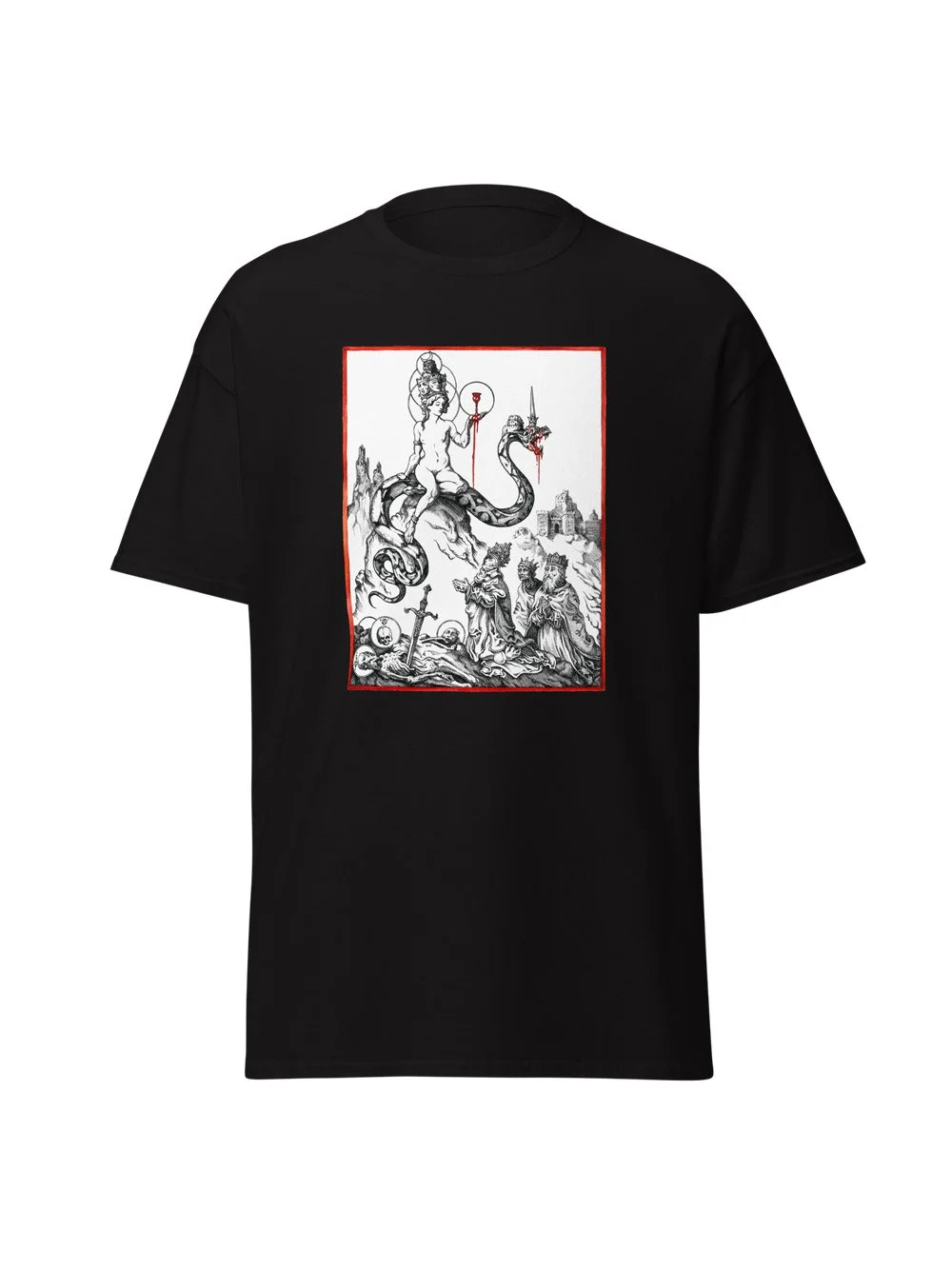
An ephemeral collaboration between Anathema Publishing Ltd. & José Gabriel Alegría Sabogal.
(Officially licensed artwork © Anathema Publishing Ltd. & José Gabriel Alegría Sabogal.)
• 100% cotton
• Sport Grey is 90% cotton, 10% polyester
• Ash Grey is 99% cotton, 1% polyester
• Heather colors are 50% cotton, 50% polyester
• Fabric weight: 5.0–5.3 oz/yd² (170-180 g/m²)
• Open-end yarn
• Tubular fabric
• Taped neck and shoulders
• Double seam at sleeves and bottom hem
• Blank product sourced from Honduras, Nicaragua, Haiti, Dominican Republic, Bangladesh, Mexico
Disclaimers:
• Due to the fabric properties, the White color variant may appear off-white rather than bright white.
• Dark color speckles throughout the fabric are expected for the color Natural.
* Unlike the other items on offer in the online store, orders for apparel are packaged and dispatched from a different location rather than Anathema's main Canadian offices. As a result, the delivery time for clothing may vary and be different from that of other items in the same purchase. (For example, should a customer order a t-shirt, a music CD, and a few books, the items will arrive in different boxes and at different times from two different distribution centers.)
** This product is made especially for you as soon as you place an order, which is why it takes us a bit longer to deliver it to you. Making products on demand instead of in bulk helps reduce overproduction. Thank you for making a thoughtful purchasing decision.
Age restrictions: For adults
EU Warranty: 2 years
Other compliance information: Meets the flammability, lead, cadmium, phthalates and formaldehyde level requirements.
In compliance with the General Product Safety Regulation (GPSR), Oak inc. and SINDEN VENTURES LIMITED ensure that all consumer products offered are safe and meet EU standards. For any product safety related inquiries or concerns, please contact our EU representative at gpsr@sindenventures.com. You can also write to us at 123 Main Street, Anytown, Country or Markou Evgenikou 11, Mesa Geitonia, 4002, Limassol, Cyprus.
JOSÉ GABRIEL ALEGRÍA SABOGAL ORIGINALS
![Hermes Trismegistus — Pimander — Asclepius [3 pieces]](https://images.squarespace-cdn.com/content/v1/63f0dc03f3010727a440d3a6/3e401fda-1c0d-48d6-bbb6-891be3ae525d/HERMETICA_3-pieces.jpg)
Pieces drawn for David Litwa’s edition of the Hermetica I: The Corpus Hermeticum, Asclepius, and Nag Hammadi Hermetica Ordered as a Path of Initiation, published by Fount Ultd., in 2026.
Hermes’ portrait on follows the pavement of Siena cathedral and early printed editions of Sacrobosco’s De Sphaera.
The two horizontal pieces stand for the two major beginning and ending treatises of the Corpus. Namely the Pimander, which opens with Hermes’ great vision of the cosmic serpent and the planetary spheres. Visually, it is largely based on the frontispieces of Pignoria’s exposition on the Mensa Isiaca, and the Hieroglyphs are from the Metternich Stele, often called the magical stele, which I could draw at the MET, New York. The volcano in the background is a reference to Khunrath’s depiction of the emerald tablet in his Amphitheatrum of 1595. The Latin text of the tablet is also inscribed on the following drawing’s corner. The triple herma pillar of Hermes is based on Johannes Hergavius’ (1557–1558) printer’s mark.
The opposite piece, the Asclepius, illustrates the prophecy therein on Egypt’s spiritual decline, that has been called “the Lament” by Frances Yates (Giordano Bruno and the Hermetic Tradition, 1964), when Egypt will no longer be full of temples, but it will be full of tombs, hence the mourning figure. The late Alexandrian character of the text is stressed by composite deities, like the dog-headed Hermanubis or the so-called Canopus Deus of the Nile.
*Sales protocol for these original pieces will be unique in that, after a purchase is made on our website, we will personally reach out to each customer to arrange a customized shipping plan, ensuring both parties are aligned on what can and cannot be done to guarantee safe and smooth delivery of the items.
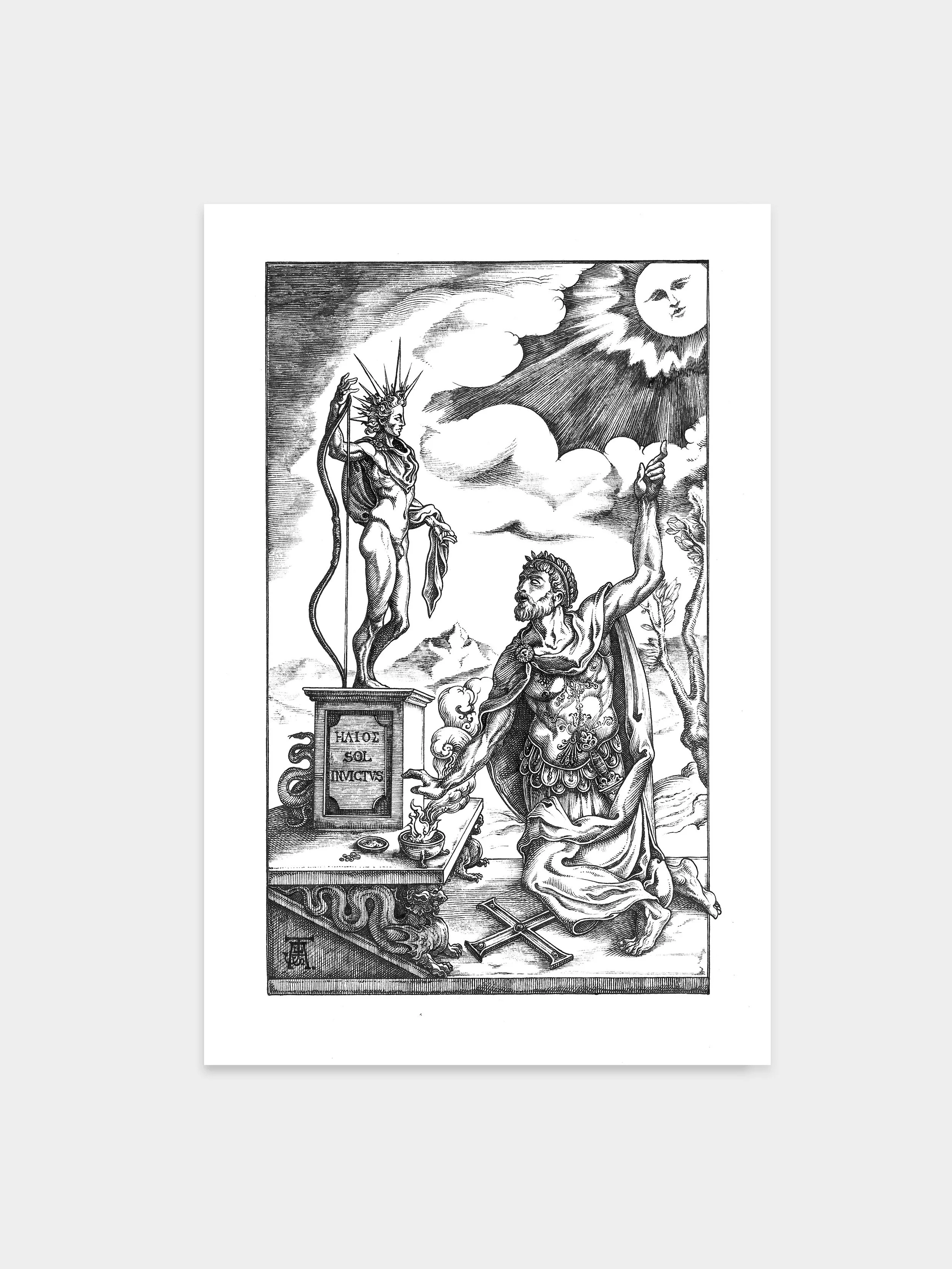
The famous last pagan emperor who rejected Christianity and promoted his cult of the Sol Invictus, along with that of the Great Mother. This cult of the Sun had been established by Aurelian, and Franz Cumont proposed that Julian had also major eastern influences from Persia, paradoxically, it was his war with Persia that brought him to his end.
This is a reconstruction of pagan worship inspired by Fritz Saxl’s “Pagan Sacrifice in the Italian Renaissance” (1939) and the living practice of puja in Hinduism. It is reworked from Achille Bocchi’s Symbolicarum Quaestionum of 1574, in which symbol LIIII depicts a sacrifice to Asclepius. Helios holds Apollo’s bow, which is given his same size, echoing depictions of Rama.
*Sales protocol for these original pieces will be unique in that, after a purchase is made on our website, we will personally reach out to each customer to arrange a customized shipping plan, ensuring both parties are aligned on what can and cannot be done to guarantee safe and smooth delivery of the items.
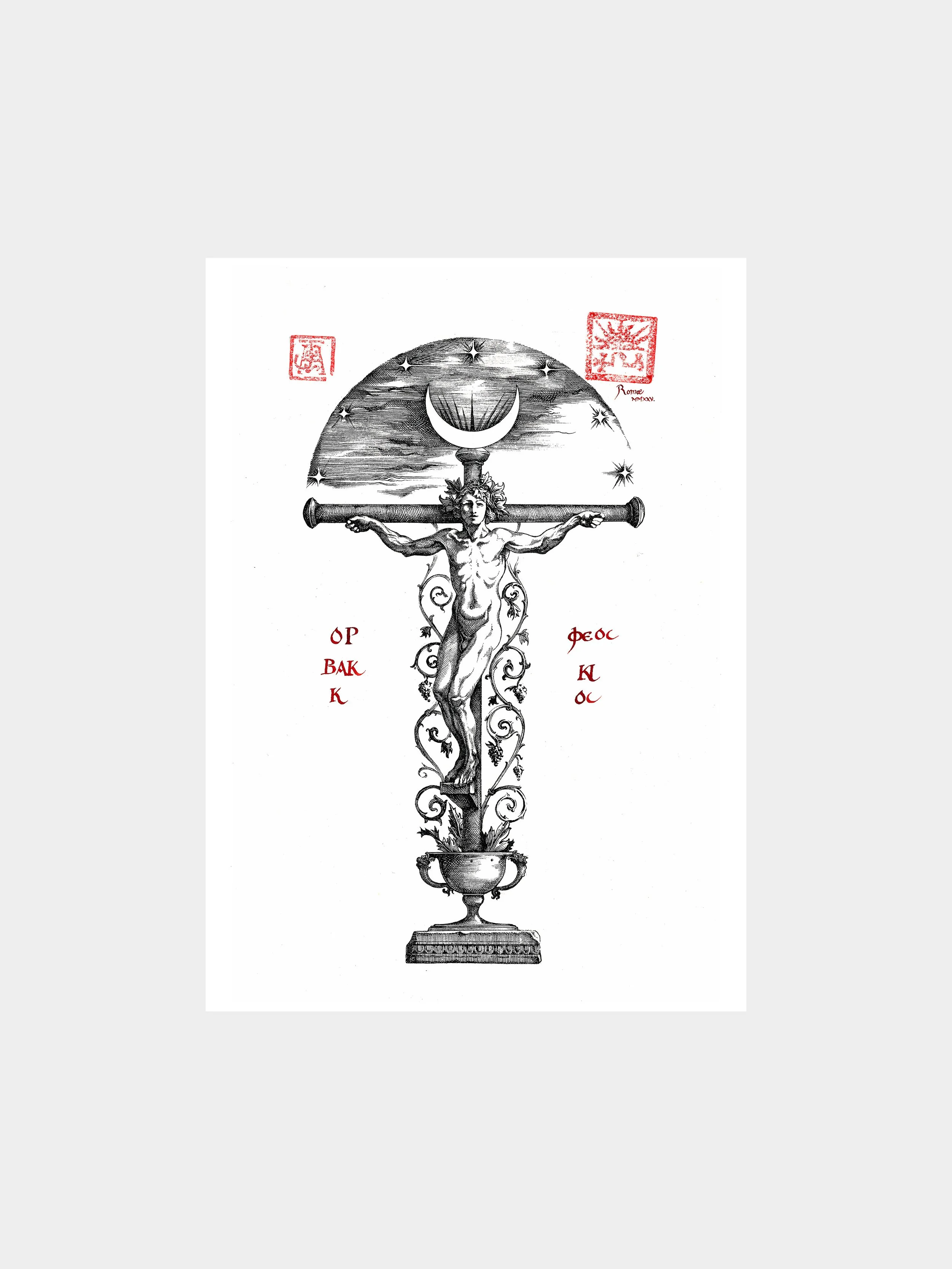
A playful reinterpretation of the controversial gem of Berlin that has been lost since World War II. Francesco Carotta (2008) has argued that the original may have represented a form of roman tropaion, a memorial trophy, probably erected for the mourning of Julius Caesar, as the iconography does not coincide with early depictions of the crucifixion, either Christian or otherwise.
However, to my eyes the idea of a bacchic Christ is simply too good to miss. His cross thus emerges from the wine krater, it is crowned by the crescent moon and the seven Pleiades, which constitute the lyre of Orpheus, and I have tried to respect the odd rendering on the original inscription.
It has often been commented in Art History how the crucifixion is rather scarce in early Christian art, and so is the suffering that would come to characterize the late medieval forked crosses or crucifixus dolorosus. Instead, this is a blissful crucifix, corresponding to a mystery that was left unanswered, he probably left us behind laughing.
*Sales protocol for these original pieces will be unique in that, after a purchase is made on our website, we will personally reach out to each customer to arrange a customized shipping plan, ensuring both parties are aligned on what can and cannot be done to guarantee safe and smooth delivery of the items.
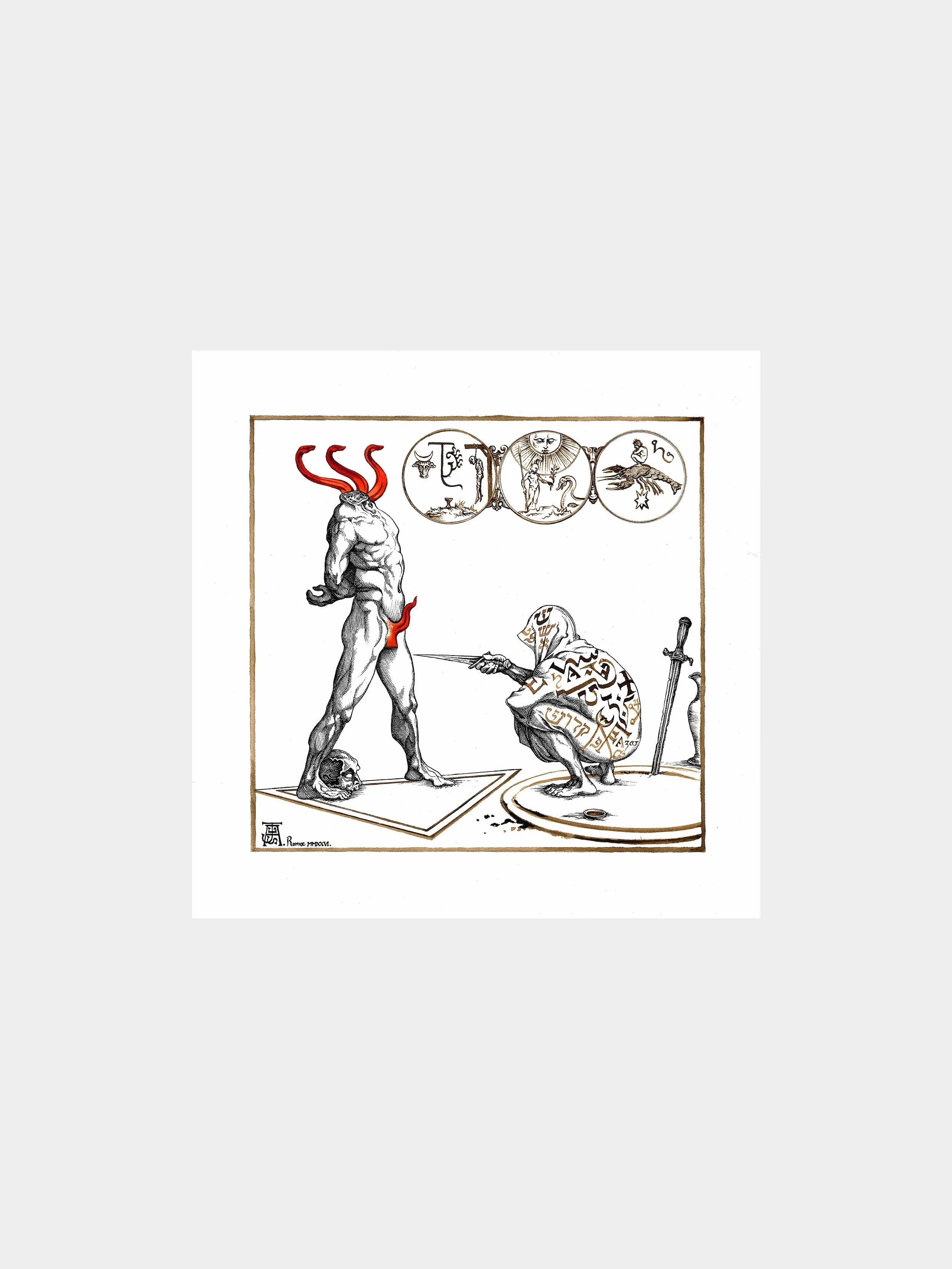
The famous Headless or Bornless Rite, reimagined as performed by a contemporary goes. The upper astrological medallions (hanged man in Taurus, Aeneas with the Golden Bough, the decans of Cancer) are a personal choice that correspond to my own performance of the rite and therefore I will refrain from explaining them further.
The torso of the Headless figure is based on the old centaur from the Furietti centaurs group at the Capitoline museums in Rome. Comparing it with surviving late antique gems, Campbell Bonner (1950) has interpreted that the figure in the Papyri has several snake heads, often in uneven numbers.
Preisendanz (1927) interpreted the mysterious phrase “with my sight on my feet” as referring to the beheaded prisoners in ancient Egyptian depictions such as the Narmer palette, the head between their legs could therefore be seen as a curse preventing them from coming back to life, but also potentially damning them to wander the world as undead corpses instead.
The phallic character of the figure is a reference to the popular cornicello amulets of Naples, direct descendants of the ancient fascinus amulets with apotropaic purposes. The goes is therefore commanding the unhappy spirit to do his bidding, with the necessary protective devices, among them the clothes of a man who has died violently.
*Sales protocol for these original pieces will be unique in that, after a purchase is made on our website, we will personally reach out to each customer to arrange a customized shipping plan, ensuring both parties are aligned on what can and cannot be done to guarantee safe and smooth delivery of the items.
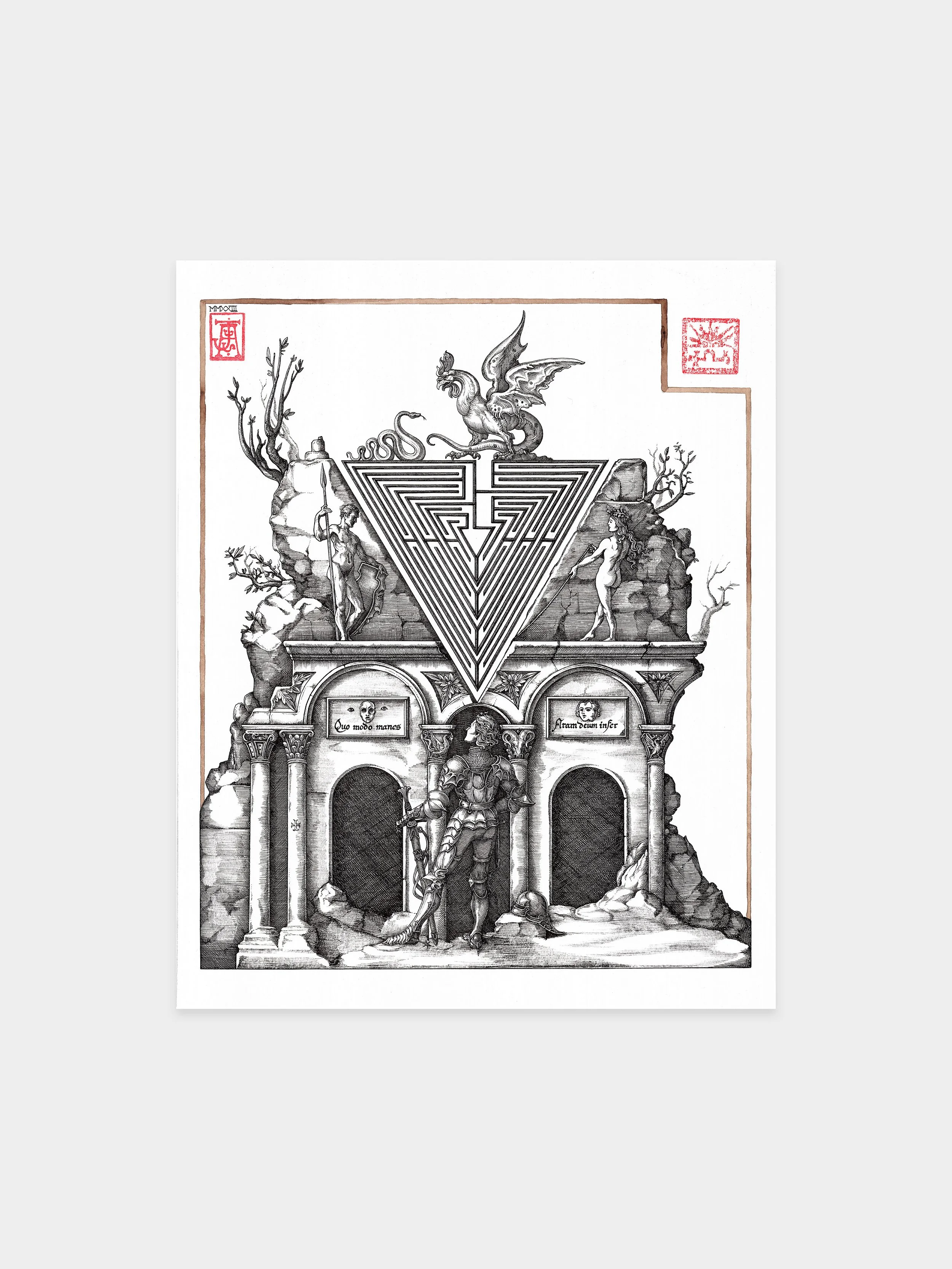
This triangular labyrinth was designed by Johannes Stabius and published in his Figura Labyrinthi of 1504. Theseus and Ariadne stand on the sides.
The knight stands before two gates with two enigmas: quo modo manes, the face with its eyes out for representing the gods of the underworld, appeared in the French edition of Horapollo’s Hieroglyphica (Paris, 1551), while the two merged faces as a constructed hieroglyph meaning “to the gods of the underworld” appears in Francesco Colonna’s Hypnerotomachia Poliphili of 1499.
The basilisk was believed to kill with its mere sight. Thus, it is all an emblem of death.
*Sales protocol for these original pieces will be unique in that, after a purchase is made on our website, we will personally reach out to each customer to arrange a customized shipping plan, ensuring both parties are aligned on what can and cannot be done to guarantee safe and smooth delivery of the items.
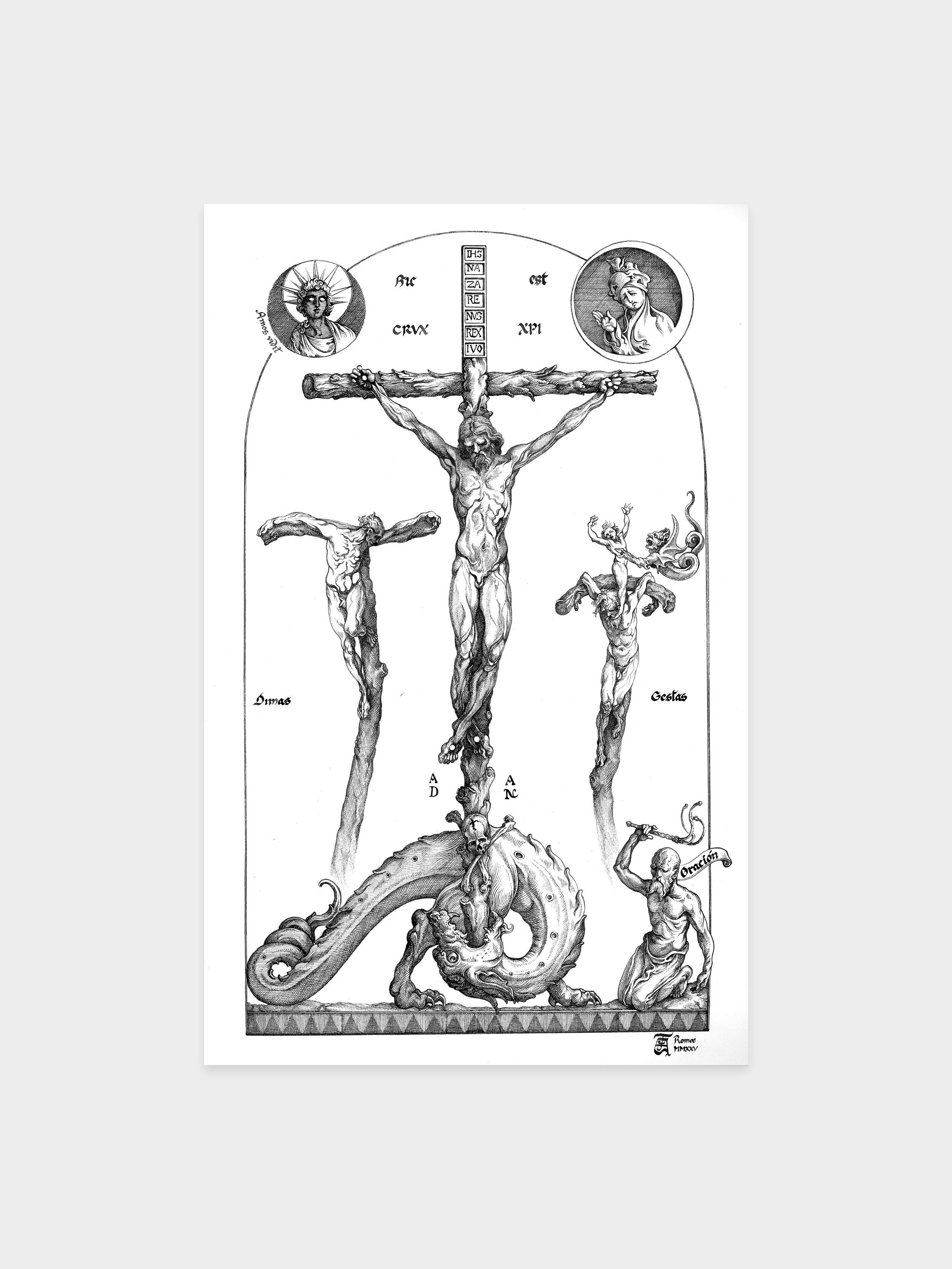
Based on Michelangelo’s bronzes of the passion group, drawn from the version at the MET, New York. The titulus crucis and the mourning Sun and Moon are inspired by the reliquary of Pope Paschal II preserved at the Abbey of Sainte-Foy de Conques.
The configuration of the cross in the dragon’s mouth is taken from the 12th century Munich Psalter, Ms.Lat.17401. fol.105. In a sense the cross defeats the old dragon, in another, it emerges from it, as prophesized by John 3:14. My self-portrait as a flagellant in prayer the corner is based on Andres de Li’s Thessoro de la Passion, 1496.
*Sales protocol for these original pieces will be unique in that, after a purchase is made on our website, we will personally reach out to each customer to arrange a customized shipping plan, ensuring both parties are aligned on what can and cannot be done to guarantee safe and smooth delivery of the items.
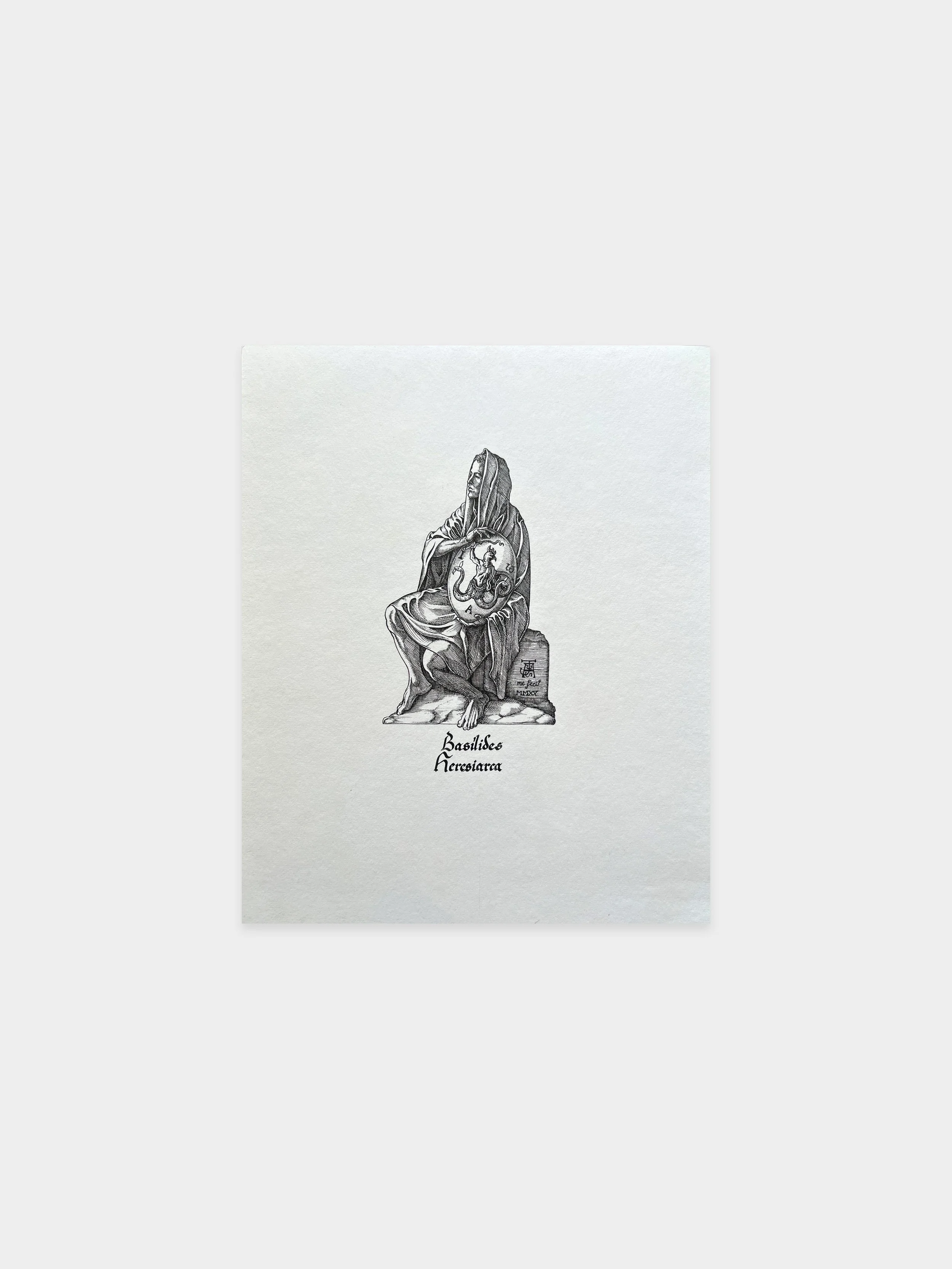
[This piece has been featured in IAO: Ophite Iconography, p.93.]
Basilides has been the Gnostic teacher largely attributed as the founder of Alexandrian or pagan streams of Gnosticism, while Simon Magus was considered to be the founder of the Judaic forms of Gnosis, by the polemical sources of their time: Irenaeus of Lyon, Hippolytus of Rome and Origen of Alexandria.
Basilides may have been Egyptian, and he was said to be the disciple of Glaucias, who, in turn, had been a disciple of Peter. As such, although considered a heresy, it was certainly one of the early expressions of Christianity. He has also been historically credited as the creator of the so-called Abraxas figure, later identified as the type of a rooster headed giant
with snake legs (for this attribution see: Chiflet, Jean. Joannis Macarii, Abraxas, seu Apistopistus. Antwerp: Balthasar Moretus, 1657.)
Hippolytus describes how Abraxas is the supreme archon ruling over 365 heavens, and he may have been responsible for the curious misspelling that took hold in later literature: the actual name found on gems and profusely in magical papyri is Abrasax.
But in my idealized portrait I consciously chose to follow the stream of this historiography and tradition.
*Sales protocol for these original pieces will be unique in that, after a purchase is made on our website, we will personally reach out to each customer to arrange a customized shipping plan, ensuring both parties are aligned on what can and cannot be done to guarantee safe and smooth delivery of the items.
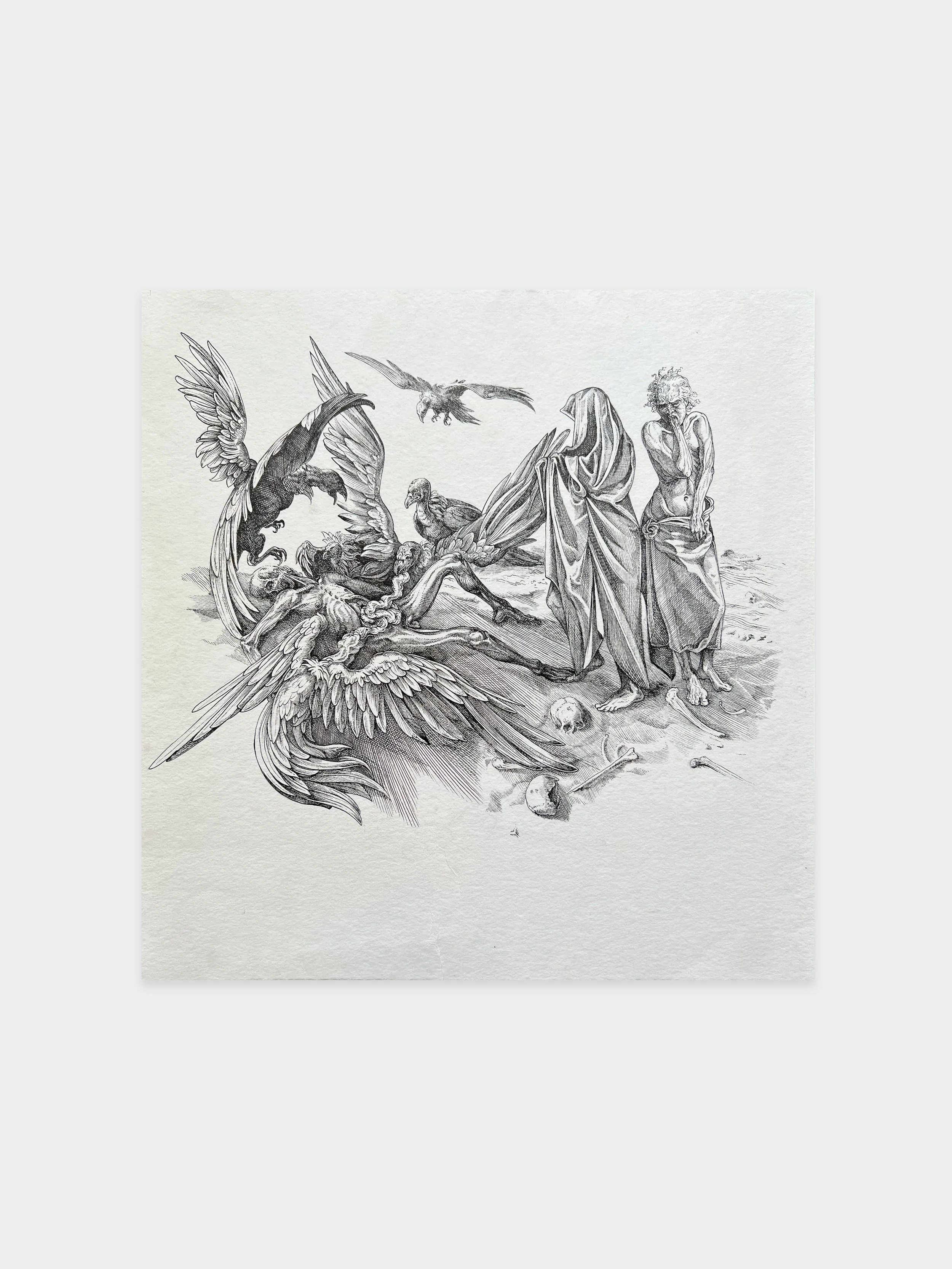
Vultures and the praxis of sky burial or the towers of silence have been a long-lasting fascination for me. Black vultures are a common sight in the peruvian desert of which I am very fond of, but rarely do they taste human flesh anymore. I follow Michael Maier in the opinion that vultures are among the noblest of animals, for they neither they need nor steal anything from humans, and they were the object of ancient divination practices “as the foundation of the city of Rome may declare” (Michael Maier. Atalanta Fugiens. Oppenheim, Hyeronimus Galler, 1618, Discursus XLIII, p.183.) A couple of spectators behold the end of flesh, following the tradition of Dante and Virgil’s travel, one remains silent in understanding, the other turns away in horror, and bites his own hand following the saying in Ecclesiastes 4:5, “The fool folds his hands and consumes his own flesh.”
*Sales protocol for these original pieces will be unique in that, after a purchase is made on our website, we will personally reach out to each customer to arrange a customized shipping plan, ensuring both parties are aligned on what can and cannot be done to guarantee safe and smooth delivery of the items.
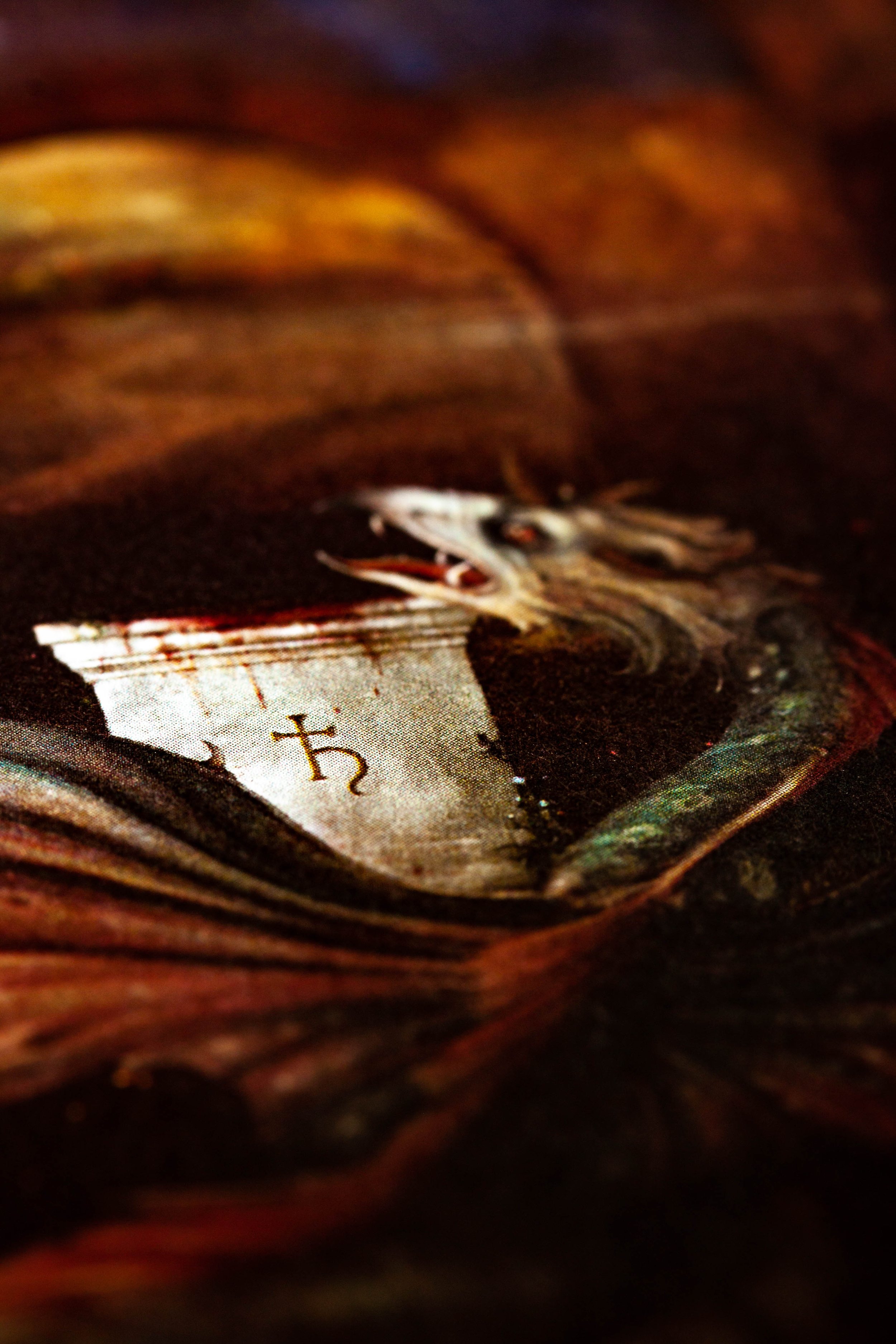
N.B.: Art Prints are shipped separately from other items due to their box format, so please order them separately from other books or items to avoid extra shipping charges.
Babalon the Great, Woman of Babylon
by Jose Gabriel Alegría Sabogal
11” X 13.75” - Printed on lavish and highly-textured Velvet Fine Art Paper 260 gsm paper-carton.
Limited to approx. 150 signed and stamped copies.
This drawing is a play of words translated onto an image. In Dante’s Inferno, the infamous Whore of Babylon is described as having 7 heads herself, instead of, as traditionally visualized by painters, the dragon being multi-headed. This called to my attention that the passage in Revelation 17:3 can indeed be understood in both ways: “There I saw a woman sitting on a scarlet beast that was covered with blasphemous names and had seven heads and ten horns.”
In the words of Charles T. Davis “Dante eliminates the beast and gives the seven heads to the woman, thereby identifying her firmly with Rome, the papal as well as the imperial city (Davis, 1998, p.269):
She is described as sitting on the seven hills (implicitly the seven sacred hills of ancient Rome) a link to Dante’s imperial and anti-papal views, and she has also been depicted in medieval visual tradition as sitting on the hills only, or on a hill with seven rivers, see for example the so-called Paris Apocalypse (Ms. Français 403, fol.33r.) and the Gulbenkian Apocalypse (fol.58).
I however have chosen to include the beast and the city combined, although in a simplified way, given the play of words for “draco” to mean both serpent and dragon. In the end, it is also in Revelation that Satan is referred to as “that old serpent”. This serpent has one horn as is wounded, the miracle through which the Antichrist would convert the gullible to worship him, tropes that st. John took from the prophecy of Daniel 7.
The Greek inscriptions on the haloes of the slain saints are the abbreviations for “prophet” and “apostle” as inscribed in the Porta Byzantina of the papal Basilica of San Paolo fuori le mura. They have been slain with the blessed sword (stocco benedetto) that was a papal gift to kings and emperors, last awarded in 1823.
The term babálon is Enochian for “to the wicked” as recorded by John Dee (Sixth Key, 6:12, James, 2009) and rose to prominence in Thelema to designate the Scarlet Woman, a particular interpretation of the apocalyptic figure of the whore. I rendered a previous version of the Whore of Babylon as fully clothed, which I have published a couple of times (Handbook of Sacred Anatomy, Semesilam) where she is based on Dürer’s sketch for the Slander of Apelles, from 1522, preserved in the Albertina in Vienna (nr.3177). Even though the current version is less prudish, it is always my aim to depict dignity in damnation. Lastly, the landscape behind is a mixture of St. Peter’s and the Gate of Ishtar, expressing Dante’s conflation of the two seats of power.